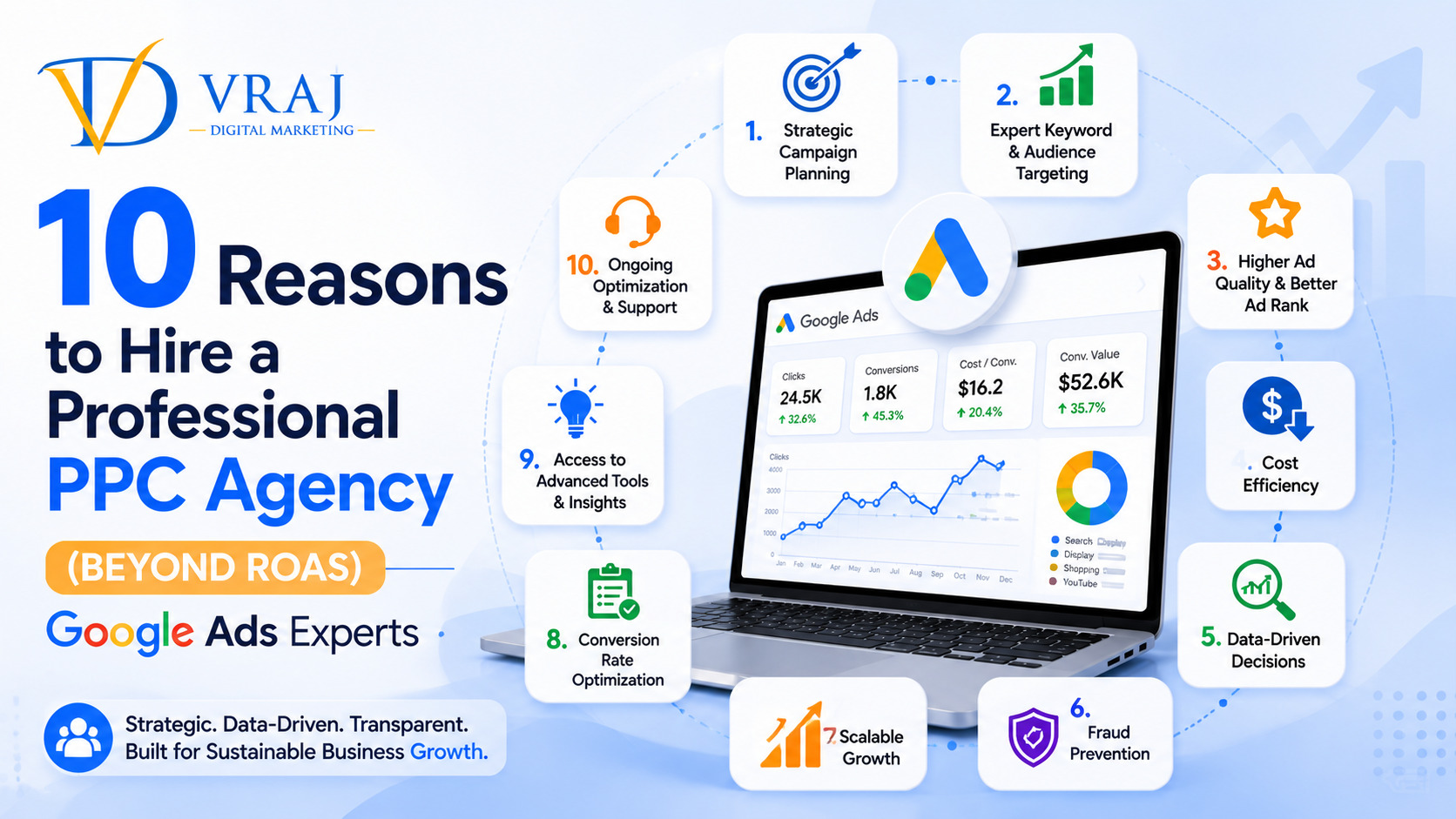
10 Reasons to Hire a Professional PPC Agency (Beyond ROAS) | Google Ads Experts
Hiring a PPC agency is one of the smartest investments a business can make — if you choose the right one. Most business owners evaluate agencies purely on return on ad spend, but that framing misses about 80% of what a great agency actually delivers.
I’m Dipesh, and over the past 4+ years managing Google Ads campaigns with over $100,000 in ad spend under my belt, I’ve seen what separates businesses that scale with paid search from those that burn through budget and quit. The difference almost never comes down to ROAS alone.
Here’s what it actually comes down to.
What Does a PPC Agency Actually Do That I Can't Do Myself?
A PPC agency builds and manages the entire paid search system — from keyword architecture and audience segmentation to bid strategies, landing page alignment, and conversion tracking — not just the ads themselves.
Business owners often underestimate how many moving parts exist inside a single Google Ads account. When you’re running your own campaigns, you’re likely fixing what’s visibly broken. An agency is preventing problems before they cost you money. That’s the real difference.
In my experience, the accounts I’ve inherited from self-managed setups almost always have the same issues: broad match keywords eating budget, no negative keyword lists, conversion tracking firing on the wrong page, and ad groups so diluted that Quality Scores tank. Every one of those problems silently drains spend.
Why Is Google Ads Account Structure More Important Than Most People Think?
Poor account structure is the single most common reason Google Ads campaigns underperform. It directly affects Quality Score, ad relevance, and cost-per-click — and a weak structure means you pay more for worse placement.
According to Google’s own internal data, advertisers with tightly themed ad groups see Quality Scores averaging 7–9, compared to 3–5 for loosely structured accounts. A one-point Quality Score improvement can reduce your CPC by up to 16%. That’s money staying in your pocket on every single click.
A professional PPC agency builds accounts the way Google rewards. Single keyword ad groups (SKAGs) or tightly themed ad groups, proper campaign segmentation by intent, and dedicated landing pages per offer. It’s not glamorous work. But it compounds.
Can a PPC Agency in India Deliver Results for USA-Based Businesses?
Yes — and this is a debate worth having honestly. A skilled PPC agency in India with demonstrated USA market experience, native English copywriting ability, and familiarity with American consumer behavior can absolutely deliver strong results for US businesses.
That said, the nuance matters. You want an agency that understands USA market seasonality (Black Friday, Q4 budget shifts, regional CPCs in competitive markets like New York or Los Angeles), not one that runs the same playbook regardless of geography.
I’ve managed campaigns specifically targeting US audiences from day one. The timezone overlap requires systems — clear reporting cadences, async communication, and fast response SLAs. When those are in place, the geographic gap becomes irrelevant. What matters is the quality of the strategy, the data interpretation, and the creative instincts behind the campaigns.
How Does a Google Ads Agency Manage Budget More Efficiently Than an In-House Team?
Agencies manage budget across multiple accounts simultaneously, which means they pattern-match faster, spot wastage earlier, and apply cross-client learnings that a single in-house manager simply never sees.
Here’s a concrete example. When iOS 14 privacy changes rolled out, agencies that managed dozens of accounts had real-time visibility into how conversion tracking was breaking across different industries. They patched client accounts within days.
Businesses managing their own campaigns often didn’t realize their data was broken for weeks — and made budget decisions on corrupted numbers during that window.
That cross-account intelligence isn’t something you can replicate with one person managing one account. It’s a structural advantage agencies have, and it shows up in efficiency.
Ready to Stop Wasting Ad Budget?
If you’re spending money on Google Ads without a clear system for tracking, optimizing, and scaling — you’re leaving revenue on the table every single day.
We’ll review your account structure, identify your top three budget leaks, and show you exactly where your campaigns can improve. No pitch. No fluff. Just data.
What Competitive Intelligence Does a PPC Agency Provide?
A professional Google Ads agency uses tools like SEMrush, SpyFu, and Google Auction Insights to map your competitors’ strategies — their ad copy angles, landing page positioning, bid aggressiveness, and keyword gaps — then uses that data to outmaneuver them.
This is where most businesses go wrong. They write ads based on what they think sounds good. Agencies write ads based on what competitors aren’t saying — the gaps in the market, the unmet objections, the angles that convert because they’re different, not because they’re loud.
SEMrush’s 2024 State of Search report found that 68% of businesses have no formal competitive monitoring process for paid search. That’s a massive blind spot. A PPC agency closes it.
How Does Conversion Tracking Affect Google Ads Performance?
Conversion tracking is the data foundation everything else is built on. Without accurate conversion data, Google’s Smart Bidding algorithms optimize toward the wrong signals — and your campaigns slowly drift toward clicks that never convert.
This is more common than you’d think. HubSpot’s 2023 State of Marketing report noted that 42% of marketers cite data quality as their top challenge. In paid search, bad data doesn’t just skew your reporting — it actively teaches the algorithm to find more of the wrong customers.
A proper Google Ads agency audits your conversion setup before touching a single bid strategy. They check for duplicate firing, missing events, cross-domain tracking issues, and GA4 integration gaps. It’s not the exciting part of PPC. But it’s the part that makes everything else work.
What's the Real Cost of Managing Google Ads Without an Expert?
The visible cost is the agency fee. The invisible cost of not hiring one is the wasted ad spend, the missed revenue from underperforming campaigns, and the opportunity cost of your own time spent learning a platform that changes every quarter.
WordStream’s 2024 PPC Benchmark Report found that businesses new to Google Ads waste an average of 25% of their budget on irrelevant clicks in the first six months. On a $5,000/month budget, that’s $1,250 gone monthly — or $15,000 per year — before you’ve even accounted for suboptimal bidding and poor ad relevance.
The agency fee looks different when you do that math.
How Does a PPC Agency Help With Landing Page and Ad Copy Alignment?
Ad copy and landing page messaging must match — the same promise, the same tone, the same call-to-action — or your Quality Score drops and your conversion rate craters. This is called message match, and agencies enforce it systematically.
Most business owners write an ad, send traffic to their homepage, and wonder why nothing converts. Here’s the thing: Google measures the expected landing page experience as part of Quality Score. A misaligned page isn’t just a CRO problem — it literally makes your ads more expensive.
I’ve seen accounts where fixing landing page alignment alone dropped CPL by 30% within two weeks. No budget increase. No new keywords. Just alignment.
Why Does Audience Strategy Matter as Much as Keywords in Modern Google Ads?
Google Ads in 2024 is not just keyword-based. Audience layering — using Customer Match, in-market segments, remarketing lists, and similar audiences — is now essential to competitive bidding strategy, especially as broad match and Smart Bidding consume more control.
According to Google’s internal data, campaigns using audience observation layers see an average of 15% improvement in conversion rate when bid adjustments are applied correctly. That’s a meaningful lift, and it’s invisible if you’re only thinking in terms of keywords.
A skilled PPC agency builds audience architecture alongside keyword architecture. They’re not the same thing, and treating them separately costs you efficiency.
How Does Ongoing Testing and Optimization Work Inside a Google Ads Agency?
A professional agency runs structured A/B tests on ad copy, landing pages, bidding strategies, and audience segments continuously — not occasionally. Optimization isn’t a monthly task. It’s a weekly cadence.
The Pareto principle applies hard in PPC: typically 20% of your keywords drive 80% of your conversions. An agency identifies that 20%, protects it, scales it, and systematically cuts the bottom 80%. That process requires discipline, not just access.
In my experience managing campaigns over four-plus years, the accounts that compound fastest aren’t the ones with the biggest budgets. They’re the ones with the most rigorous testing cadence. Consistent, documented, iterative testing is what separates accounts that plateau from accounts that scale.
Conclusion: The Right PPC Agency Is a Revenue Partner, Not a Vendor
If you’re a business owner in the USA evaluating whether to hire a PPC agency, stop asking “what’s their ROAS?” and start asking “how do they think about my account?” The strategy, the data infrastructure, the competitive intelligence, the testing discipline — that’s where the real value lives.
A great Google Ads agency doesn’t just run ads. It builds a paid acquisition system that compounds over time, gets smarter with every dollar spent, and frees you to focus on running your business instead of deciphering campaign reports.
With 4+ years of hands-on experience and over $100,000 in ad spend managed across competitive markets, I’ve seen this pattern play out with every serious business that commits to the process. The results follow.
Frequently Asked Questions
What does a PPC agency do?
A PPC agency manages every aspect of your paid advertising campaigns — from account setup, keyword research, and ad copywriting to bid management, audience targeting, and performance reporting. The goal is to maximize the return on your ad spend while minimizing wasted budget. A good agency also handles conversion tracking, landing page feedback, and ongoing A/B testing as part of its core service.
How much does it cost to hire a PPC agency?
Most PPC agencies in the USA charge either a flat monthly retainer or a percentage of ad spend, typically ranging from 10%–20% of your monthly budget. A boutique agency might charge $500–$1,500/month for smaller accounts, while larger agencies managing significant budgets can charge $3,000–$10,000+. The right question isn't what the agency costs — it's whether their management generates more revenue than you'd produce managing it yourself.
Is a PPC agency in India a good choice for US businesses?
It can be an excellent choice, provided the agency has demonstrated experience with USA market dynamics, strong English copywriting ability, and a clear communication structure. Many Indian digital marketing agencies manage substantial US client portfolios with strong results. The key vetting factors are case studies, reporting transparency, and how they handle time zone-based communication.
How long before I see results from a PPC agency?
Most accounts see initial data and early optimizations within the first 30 days. Meaningful performance trends typically emerge in 60–90 days, once the algorithm has accumulated enough conversion data to optimize Smart Bidding strategies effectively. Accounts with larger budgets and strong conversion tracking in place often see faster traction. Be skeptical of any agency promising dramatic results in the first two weeks.
What's the difference between a PPC agency and a Google Ads agency?
A Google Ads agency specializes specifically in Google's advertising ecosystem — Search, Display, Shopping, YouTube, and Performance Max campaigns. A PPC agency may manage paid advertising across multiple platforms including Meta Ads, LinkedIn, Microsoft Ads (Bing), and Pinterest in addition to Google. If your primary channel is Google Search, a dedicated Google Ads agency often brings deeper platform-specific expertise.
How do I know if my current PPC agency is doing a good job?
Beyond ROAS, look for these indicators: regular proactive communication (not just monthly reports), documented A/B tests and their results, a clean account structure you can inspect in Google Ads, accurate conversion tracking with no duplicate events, and clear reasoning behind budget allocation decisions. If your agency can't explain why they made a specific change in plain language, that's a problem worth addressing.
Our Blogs
Maximizing Your ROI with Google Ads in 2026
How Much Do Google Ads Cost? A Complete Guide for Entrepreneurs
Website Navigation Strategies for Optimal Website Performance
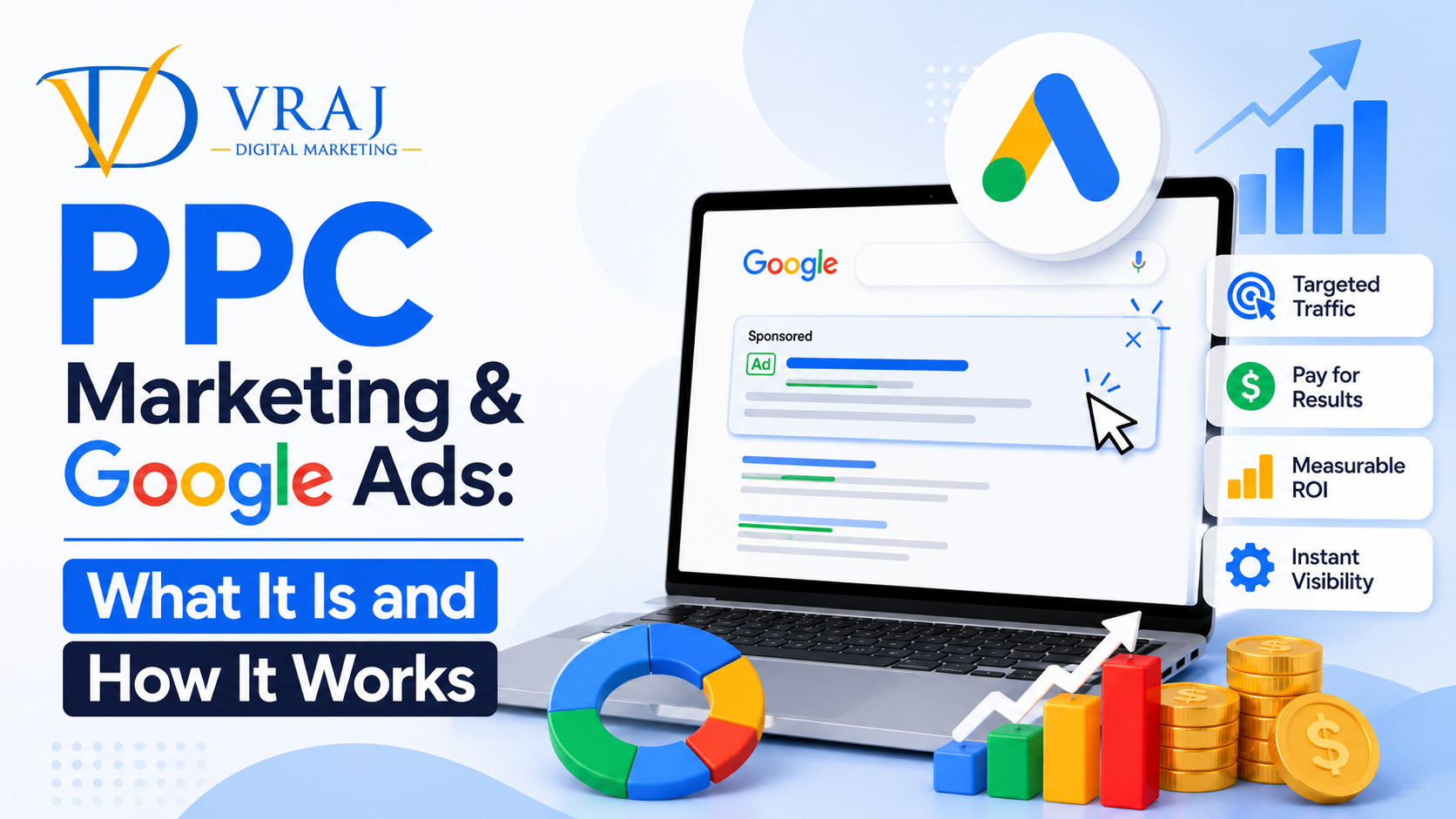
PPC Marketing & Google Ads: What It Is and How It Works
What Is PPC Marketing?
PPC marketing or Pay per click marketing is a digital marketing advertising model where founders or businesses pay money for clicks or views. Organic ways take some time to get returned back. By using PPC marketing, founders can generate sales or leads within seven days. It works on several platforms such as Google, Bing, or social media. You can start PPC for small businesses to large businesses, PPC marketing delivers measurable, scalable results that directly support your revenue goals.
How Does PPC Marketing Work?
PPC marketing operates on a bidding system. Advertisers compete for ad placements by bidding on specific keywords. When a user searches for a term that matches your keyword, the platform runs an instant auction. The winner earns the top ad spot. You only pay when someone clicks your ad — not when they simply see it. This makes PPC one of the most cost-efficient advertising strategies available today, giving you full control over your budget and audience targeting.
Understanding Google Ads: The #1 PPC Platform
Google Ads is one of the largest PPC platforms. It allows businesses to display ads across Google search, YouTube, Gmail and Millions of partners website through Google Display Network. Over 8.5 billion searches happen on Google every day.
Types of Google Ads Campaigns
- Search Ads – Text-based ads that appear at the top of Google search results
- Display Ads – Visual banner ads shown across Google’s partner websites
- Shopping Ads – Product listings with images and prices for eCommerce stores
- Video Ads – Ads shown before or during YouTube videos
- App Campaigns – Ads promoting mobile app downloads across Google’s network
- Local Ads – Ads targeting nearby customers for physical store visits
- Performance Max – AI-powered campaigns that run across all Google channels
Key Components of a Successful PPC Campaign
Running a profitable PPC campaign requires more than just setting a budget. Every element must work together strategically. Here are the core components you need to master:
1. Keyword Research
Keyword research is one of the important parts in PPC marketing. You need to select proper keywords and then make ad group accordingly, It helps in quality score and sales or leads generation.
2. Ad Copywriting
Great ad copy drives clicks and conversions. Follow these key points to write high-performing Google Ads:
- Write a powerful headline — Include your primary keyword and lead with a clear benefit
- Craft a compelling description — Highlight your USP and address the user’s pain point directly
- Use a strong CTA — Be specific: “Get a Free Quote” beats “Click Here” every time
- Add ad extensions — Use sitelinks, callouts, and call extensions to boost visibility at no extra cost
- Match copy to search intent — Align your message with what the user actually wants
- A/B test regularly — Run 2–3 ad variations and keep the best performer
- Follow Google’s ad policies — Avoid misleading claims and ensure your landing page matches the ad
3. Quality Score
Google Ads assigns a quality score from 1 to 10 to each keyword. It depends on Landing Page, Ad relevance and Expected CTR. The more quality score you have the less CPC will require.
4. Landing Page Optimization
Send users to a dedicated landing page that matches the ad’s message. A fast, mobile-friendly page with a clear CTA converts visitors into leads and customers efficiently.
5. Bid Strategy
Choose the right bidding strategy for your goal — whether that’s maximizing clicks, targeting a specific CPA (Cost Per Acquisition), or improving return on ad spend (ROAS).
Bid strategy defines how you campaign will work. Following are bid strategies
Automated Bid Strategies:
- Target CPA (Cost Per Acquisition)
- Target ROAS (Return on Ad Spend)
- Maximize Conversions
- Maximize Conversion Value
- Enhanced CPC (ECPC)
Manual Bid Strategies:
- Manual CPC (Cost Per Click)
Awareness-Based Bid Strategies:
- Target Impression Share
CPM (Cost Per Thousand Impressions) - tCPM (Target CPM)
Video Bid Strategies:
- CPV (Cost Per View)
- Target CPV
6. Conversion Tracking
Conversion is one of the most important parts in Google Ads. Before starting any ads You should make proper conversion actions
Conversion actions are
- Form submibssion
- Call
- Add to cart
- Checkout
How Google Ads Auction Works
Every time someone performs a Google search, an automated auction takes place in milliseconds. Google determines which ads appear and in what order using a formula called Ad Rank. Here’s how it breaks down:
Ad Rank = Bid Amount × Quality Score × Expected Impact of Ad Extensions
A higher Ad Rank means better placement. This means you don’t always need the highest bid to win. A well-optimized ad with a high Quality Score can outrank competitors who spend more. This levels the playing field for businesses of every size, making Google Ads both fair and performance-driven.
Benefits of PPC Marketing for Your Business
PPC marketing delivers distinct advantages that organic SEO alone cannot always provide. Here’s why thousands of businesses invest in it daily:
- Immediate Results – Your ads go live within hours of campaign launch, unlike SEO which takes months
- Precise Targeting – Reach users by location, device, language, age, interests, and search intent
- Full Budget Control – Set daily and monthly limits; never overspend your advertising budget
- Measurable ROI – Track every click, conversion, and rupee spent with real-time data
- Brand Visibility – Even if users don’t click, your brand appears at the top of search results
- Competitive Edge – Appear above organic results and outrank competitors instantly
- Scalability – Scale successful campaigns up or down based on performance and business needs
PPC Marketing vs. SEO: What's the Difference?
Many business owners wonder whether they should invest in PPC marketing or SEO. The truth is — both work best together. Here’s a clear comparison:
| Feature | PPC Marketing | SEO |
|---|---|---|
| Speed | Instant results | Takes 3–6 months |
| Cost | Pay per click | Free (time investment) |
| Visibility | Top of search page | Below paid ads |
| Targeting | Highly precise | Broader audience |
| Long-term Value | Stops when budget ends | Compounds over time |
For businesses that need leads now, PPC delivers. For sustainable long-term growth, SEO builds authority. Together, they form a complete digital marketing strategy.
How to Set Up Your First Google Ads Campaign
Follow these steps to launch your first PPC campaign on Google Ads:
- Create a Google Ads account at ads.google.com
- Set your campaign goal (Sales, Leads, Website Traffic, etc.)
- Choose your campaign type (Search, Display, Shopping, etc.)
- Define your target audience — location, language, device
- Research and add keywords relevant to your business
- Write your ad copy — headline, description, and display URL
- Set your daily budget and bidding strategy
- Create or optimize your landing page
- Enable conversion tracking via Google Tag or Google Analytics
- Launch the campaign and monitor performance daily
Common PPC Mistakes to Avoid
Even experienced marketers make costly errors. Avoid these common PPC pitfalls:
- Ignoring negative keywords — Block irrelevant searches to save budget
- Sending traffic to the homepage — Always use a specific, relevant landing page
- Not testing ad variations — Run A/B tests to find the best-performing copy
- Skipping conversion tracking — You can’t optimize what you don’t measure
- Setting and forgetting — PPC campaigns require regular monitoring and adjustments
Frequently Asked Questions
What does PPC stand for in marketing?
PPC stands for Pay-Per-Click. It is a digital advertising model where advertisers pay a fee each time a user clicks on their ad. It allows businesses to buy targeted website traffic instantly rather than earning it organically through SEO.
How much does PPC marketing cost in India?
PPC costs vary widely based on your industry, competition, and keywords. In India, the average cost-per-click (CPC) ranges from ₹5 to ₹200 or more. You set your own daily budget, so you have complete control over spending. Even a modest daily budget of ₹500–₹1,000 can generate measurable results for local businesses.
Is Google Ads the same as PPC?
Google Ads is the most popular PPC platform, but they are not exactly the same thing. PPC is the broader advertising model, while Google Ads is one specific platform that uses the PPC model. Other PPC platforms include Meta Ads, Microsoft Ads, LinkedIn Ads, and Amazon Ads.
How long does it take to see results from PPC?
Unlike SEO, PPC delivers results almost immediately. Once your campaign goes live and Google approves your ads (usually within a few hours), you can start receiving clicks and leads the same day. However, optimal performance typically takes 2–4 weeks of data collection and campaign refinement.
Can small businesses benefit from PPC marketing?
Absolutely. PPC marketing is highly scalable, making it ideal for businesses of any size. Small businesses can start with a limited daily budget, target a specific local area, and compete with larger brands by focusing on niche, high-intent keywords. The key is smart campaign setup and continuous optimization.
What is a good click-through rate (CTR) for Google Ads?
The average CTR for Google Search Ads across all industries is around 3–5%. A CTR above 5% is considered strong. A low CTR often signals that your ad copy needs improvement or that your keywords don't match your audience's intent closely enough.
Do I need a PPC agency or can I manage it myself?
You can manage Google Ads yourself, especially for simple campaigns. However, working with a certified PPC agency like Vraj Digital Marketing ensures your budget is spent efficiently, campaigns are continuously optimized, and you achieve the best possible return on investment — saving you both time and money.
Our Blogs
Maximizing Your ROI with Google Ads in 2026
How Much Do Google Ads Cost? A Complete Guide for Entrepreneurs
Website Navigation Strategies for Optimal Website Performance
Maximizing Your ROI with Google Ads in 2026
Why Google Ads ROI Matters More Than Ever in 2026
The founder’s goal is to get a return on every dollar spent on Google Ads. In 2026, getting more business with Google Ads requires proper optimization for each campaign. At Vrajdigitalmarketing, we work on Maximizing Your ROI with Google Ads in 2026 and provide proper ROI to Founders.
Start with a Clear Goal Before You Spend a Single Rupee
Before starting any PPC campaigns, we need to define our objective then after we should select the campaign.
- Lead generation: Optimize for form submissions or calls
- E-commerce sales: Focus on ROAS (Return on Ad Spend)
- Brand awareness: Use reach and impression share metrics
- App installs: Leverage App campaigns within Google Ads
Setting the right conversion goal ensures Google ads’s algorithm to optimize your bude in right direction. Vraj digital marketing considers conversion tracking is the first step, As the Google Ads agency we need to start from this step.
2. Conduct Deep Keyword Research to Target Buyer Intent
- Keyword selection is an important part for search campaign. You need to select keywords as per intent such as commercial, information, YOY changes, three month changes, etc.
- You can use Google Ads Keyword Planner to check volume, competition, Lower price bid, high price bid, etc.
- Currently for AI, try use maximum Long tail keywrods. For example “Best PPC agency in India”
- Separate branded and non-branded keywords into different campaigns
- Add negative keywords from day one to stop irrelevant clicks
- Monitor Search Term Reports weekly and refine continuously
Strong keyword strategy is the backbone of any campaign that consistently delivers ROI.
3. Build High-Converting Landing Pages, Not Just Ads
Your Google ads campaign drives more traffic and your landing page closes the conversion. Improper landing page decreases leads generation or sales.
Key landing page principles:
- Match the headline of your ad with the landing page headline
- The landing page should open in 3 seconds.
- Landing page must have best CTAs
- Use trust signals such as company logos, testimonials, ratings, certifications, etc.
- Our website and landing page must be mobile responsive.
A top-performing PPC agency always A/B tests landing pages alongside ads.
4. Use Smart Bidding Strategies the Right Way
Google’s AI-powered Smart Bidding can dramatically maximize Google Ads ROI — but only when configured correctly.
Top bidding strategies in 2026:
| Strategy | Best For |
|---|---|
| Target ROAS | E-commerce with sufficient conversion data |
| Target CPA | Lead generation campaigns |
| Maximize Conversions | New campaigns with limited data |
| Enhanced CPC | Campaigns needing manual control with some automation |
Never switch bidding strategies too frequently. Allow at least 2–4 weeks of data before evaluating performance. Work with an experienced Google Ads agency to make these decisions backed by data.
5. Leverage Ad Extensions to Increase Click-Through Rate
Ad extensions give your ads more real estate on the search results page and directly boost your CTR at no extra cost per click.
Extensions every campaign must use:
- Sitelink extensions — Direct users to specific pages
- Callout extensions — Highlight offers like “Free Consultation” or “No Setup Fee”
- Call extensions — Let users call directly from the ad
- Structured snippets — Showcase services or product categories
- Lead form extensions — Capture leads directly within Google Search
Using extensions strategically can increase your CTR by 10–15%, which lowers your Cost Per Click over time.
6. Track Conversions Accurately or You're Flying Blind
Without proper conversion tracking, you cannot maximize Google Ads ROI. You’ll spend more and know less.
Set up conversion tracking for:
- Form submissions (Google Tag Manager + Google Ads tag)
- Phone calls (Google forwarding numbers)
- Purchase events (for e-commerce via Google Ads + GA4)
- WhatsApp button clicks (custom event tracking)
- Link your Google Ads account to Google Analytics 4 and Google Merchant Center (for e-commerce).
This gives you complete visibility into the customer journey from click to conversion.
7. Optimize Campaigns Regularly — Ads Decay Without Maintenance
Running Google Ads is not a “set and forget” activity. Campaigns that don’t receive weekly attention start to underperform within 30 days.
Weekly optimization checklist:
- Review Search Term Reports and add negative keywords
- Pause ads with low CTR and high CPC
- Test new ad copy variations (RSAs with 15 headlines + 4 descriptions)
- Check Quality Score and improve low-scoring keywords
- Analyze device, location, and time-of-day performance
- Adjust bids based on what’s converting
Partnering with a dedicated PPC agency ensures this work happens consistently without pulling your internal team away from core business.
8. Retargeting: Convert the Traffic You're Already Paying For
Most visitors don’t convert on their first visit. Retargeting campaigns recapture that warm audience and maximize the ROI from your existing ad spend.
Retargeting tactics that work in 2026:
- Show dynamic product ads to users who viewed specific products
- Offer a discount or free consultation to hesitant visitors
- Exclude users who already converted to avoid wasting budget
- Use Customer Match to retarget your existing email list via Google Ads
- Set frequency caps to avoid ad fatigue (3–5 impressions per user per week)
Retargeting consistently delivers 2–5x better conversion rates than cold traffic campaigns.
9. Audit Your Account Every Month with a Professional Eye
A monthly Google Ads audit identifies hidden leaks in your budget and uncovers new opportunities. Many businesses overspend by 20–40% due to poor account structure.
What a professional audit covers:
- Campaign and ad group structure
- Keyword match type analysis
- Quality Score assessment
- Budget allocation across campaigns
- Impression share and auction insights
- Wasted spend on irrelevant search terms
At Vraj Digital Marketing, we offer Google Ads audits that give you a clear action plan — not just a report.
10. Work with the Right Google Ads Agency for Scalable Results
Managing Google Ads effectively requires expertise, time, and continuous testing. Many founders try to manage campaigns themselves and lose significant budget in the process.
A professional Google Ads agency delivers:
- Dedicated campaign managers with certified expertise
- Proven frameworks built from hundreds of campaigns
- Transparent monthly reporting with clear ROI metrics
- Proactive optimization, not reactive fixes
- Strategic scaling when performance targets are met
If you want to maximize Google Ads ROI without the guesswork, partnering with specialists is the smartest investment you can make.
Frequently Asked Questions
How much should I spend on Google Ads to see results?
It depends on your industry, target location and competitors. The key is to spend enough and in proper time, It will provide a constant and required goal.
How long does it take to see ROI from Google Ads?
Most campaigns require 4-8 weeks to get proper ROI. During this period, Google Ads’s algorithm learns from your conversion data. Fast changes can hurt current Google Ads performance. Patience and consistency are the key for critical optimization.
What is a good ROAS (Return on Ad Spend) for Google Ads?
10x ROAs is every digital marketer’s dream. 5x is considered as a strong ROAs for ecommerce business. For lead generation Cost Per Lead is important. Every entrepreneur and founder wants low cost per lead. The cost per lead depends on their business, landing page, target location, etc.
What is the difference between PPC and Google Ads?
PPC - Pay per click is a broader advertising model. PPC founders pay money for each clicks. Google Ads is the platform where we run ppc campaigns for Google Search, YouTube, Gmail, etc.
Can a small business afford to hire a Google Ads agency?
Yes. Many PPC agencies, including Vraj Digital Marketing, offer flexible packages designed for small and growing businesses. The cost of working with an agency is often offset by the reduction in wasted ad spend and the improvement in campaign performance.
Why is my Google Ads campaign not generating leads?
Common reasons include poor keyword targeting, weak landing, improper bidding strategies, etc. A professional Google Ads audit can identify the exact issue and provide proper way for Google Ads strategy.
Our Blogs
Maximizing Your ROI with Google Ads in 2026
How Much Do Google Ads Cost? A Complete Guide for Entrepreneurs
Website Navigation Strategies for Optimal Website Performance
SEO vs CRO: The Complete 2026 Guide to Rankings, Conversions & Revenue Growth
Introduction: Why SEO and CRO Both Matter in 2026
Every business owner who invests in digital marketing eventually faces the same question: should I focus on SEO or CRO? The debate between Search Engine Optimization (SEO) and Conversion Rate Optimization (CRO) has divided marketing teams for years. Some experts push traffic growth above everything else. Others argue that a leaking funnel wastes every visitor you earn. At Vraj Digital Marketing, we work with clients across Germany, the USA, and Australia, and the answer we give them every single time is the same — you cannot afford to choose one over the other.
SEO brings people to your door. CRO convinces them to walk in. Without SEO, nobody finds you. Without CRO, the people who do find you leave empty-handed. The businesses that dominate competitive markets in 2026 understand that these two disciplines are not rivals — they are partners. This guide breaks down exactly what SEO and CRO mean, how they differ, where they overlap, and how to deploy both together to generate real, measurable revenue growth for your business.
What Is SEO? A Practical Definition
Search Engine Optimization (SEO) is the process of improving your website’s visibility in organic search engine results on platforms like Google, Bing, and other search engines. When user searches for query such Best Digital Marketing agency in Germany or Best Digital Marketing agency in USA, then our website rank. Our pages get higher ranking through deliberate SEO efforts.
There are three core pillars in SEO that esatblish authority and relavance in SEO. Each pillar plays an important role to get organic performance, and neglecting any one of them creates a gap that competitor will exploit.
The Three Pillars of SEO
- Technical SEO:Technical SEO includes page speed optimization, mobile responsiveness, crawlability, site architecture, ore web vitals performance, structured schema, and HTTPs security. Search engine can not rank without above factors. It ensures your website meet baseline requirements for Search engine requires.
- On-Page SEO: On Page SEO focuses on content that displays to user and it works on individual page. It optimizes title tagsm meta description, header, Image alt text, internal linking, keyword placement, AI SEO, Answer based content, EEAT algorithm optimized content etc. When your On Page SEO is perfect, search engine ranks higher on SERPs.
- Off-Page SEO: Off Page SEO works everything outside your website. It includes backlinks from authoritative domains, brand mentions, digital PR, social signals and local citations. The more high quality backlinks you have, the more credibility your website earns.
What Is CRO? Understanding Conversion Rate Optimization
Conversion Rate Optimization (CRO) is the systematic process of increasing the percentage of website visitors who complete a desired action. That action might be making a purchase, submitting a contact form, booking a consultation, downloading a resource, or subscribing to a newsletter. CRO does not focus on bringing more people to your site — it focuses on making the most of the people already there.
Your conversion rate is calculated by dividing the number of conversions by the total number of visitors and multiplying by 100. If 10,000 people visit your website in a month and 200 of them make a purchase, your conversion rate is 2%. CRO asks the question: what would it take to turn that 2% into 3% or 4%? Even a single percentage point improvement can translate into hundreds of thousands of dollars in additional revenue depending on your traffic volume.
What CRO Actually Involves
- A/B Testing and Multivariate Testing: CRO teams run controlled experiments to test different versions of page elements. They might test two different headline variations, compare button colours, or experiment with entirely different page layouts. Statistical significance determines the winner, and the winning variation gets deployed to all users.
- Landing Page Optimisation: Landing pages are the frontline of conversion. CRO practitioners analyse and refine landing page copy, structure, visual hierarchy, trust signals, and calls to action to maximize the percentage of visitors who take the desired next step.
- User Experience (UX) Improvements: Friction kills conversions. CRO identifies and removes obstacles in the user journey — confusing navigation, slow checkout processes, unclear value propositions, missing trust signals — replacing them with smoother, more persuasive experiences.
SEO vs CRO: Key Differences at a Glance
Understanding the differences between SEO and CRO helps you allocate resources effectively and set realistic expectations for each strategy. While they work toward the same ultimate goal — growing your business — they operate in different parts of the marketing funnel and require different skill sets, tools, and timeframes.
Primary Focus
- SEO: Increases the volume and quality of organic traffic arriving at your website through improved search engine rankings.
- CRO: Increases the percentage of existing website visitors who take a meaningful action — purchase, enquiry, sign-up, or download.
Timeline to Results
- SEO: SEO is a long-term strategy. Most campaigns take three to six months to show significant ranking improvements, and twelve months or more to reach peak performance in competitive markets.
- CRO: CRO delivers faster feedback loops. A/B tests can produce statistically significant results within two to four weeks, and winning variations can be deployed immediately.
Measurement Metrics
- SEO Metrics: Organic traffic volume, keyword rankings, domain authority, click-through rates (CTR), impressions, and backlink profile growth.
- CRO Metrics: Conversion rate, revenue per visitor, average order value (AOV), bounce rate, time on page, cart abandonment rate, and cost per acquisition.
Tools Used
- SEO Tools: Google Search Console, Ahrefs, SEMrush, Moz, Screaming Frog, and Google Analytics.
- CRO Tools: Hotjar, Crazy Egg, Optimizely, VWO, Google Optimize, UserTesting, and Unbounce.
How SEO and CRO Work Together to Drive Revenue
The most successful digital marketing strategies in Germany, the USA, and Australia share one thing in common: they treat SEO and CRO not as separate departments, but as an integrated growth engine. The connection between the two is deeper than most marketers realise. When you optimise for SEO, you inevitably improve factors that also matter for CRO — and vice versa.
1. Search Intent Alignment Serves Both Disciplines
Google, Bing and other search engine rewards when our page matches a user’s query. We need to align with the user’s query so the user can get their desired result and we get our decided leads.
We need to implement the following things.
- Hero section
- Clear pricing
- Stronger CTAs
- Trust signals
- Answer user’s question
- Statistics
- Tabular content
- logos
2. Page Speed Improvements Benefit Both
Google uses page speed as a direct ranking factor, especially on mobile devices. A slow website drops in search results and it decreases your organic traffic. It also affects conversion rates too.
What we need to improve
- Mobile responsiveness
- Core web vitals
- FCP
- LCP
It improves our SEO and CRO performance so our website can generate more leads and desired output.
3. Mobile Optimisation Is Non-Negotiable for Both
More than 60% of global search traffic originates from mobile devices. Google index mobile version of your site first ( Mobile first indexing). If your website is not mobile responsive or not displayed properly on mobile or takes time to open it. It affects your mobile search result and decreases your ranking.
It is an important point for SEO goals and your CRO goals in one movement.
4. Content Quality Drives Rankings and Conversions
Thin, low-value content fails at both SEO and CRO. Write for humans first — search best practices second.
- Topical Authority: Deep, accurate content earns Google’s trust and improves rankings over time.
- Reader Trust: Genuinely helpful content builds brand credibility and lowers the barrier to conversion.
- Time on Page: Engaging content keeps visitors reading longer, benefiting both rankings and CTAs.
- Lower Bounce Rates: Intent-matched content reduces immediate exits, improving SEO and funnel health.
- Brand Recall: Valuable content creates positive associations that drive conversions on return visits.
5. Trust Signals Appear in Both SEO and CRO
E-E-A-T (Experience, Expertise, Authoritativeness, Trustworthiness) is Google’s framework for evaluating content quality and ranking worthiness. These same signals — author credentials, case studies, testimonials, industry certifications, clear contact information, and data-backed claims — are also the exact trust signals that CRO experts deploy to increase conversion rates. A page that demonstrates genuine expertise and trustworthiness performs better in search results and converts a higher percentage of the visitors it attracts.
E-E-A-T: The Bridge Between SEO and CRO in 2026
Google’s E-E-A-T framework (Experience, Expertise, Authoritativeness, and Trustworthiness) has become one of the most important ranking considerations for content in competitive niches. Understanding E-E-A-T is essential for any business targeting audiences in mature, competitive digital markets like Germany, the USA, and Australia. But what makes E-E-A-T particularly powerful is that the signals that satisfy Google’s quality raters are precisely the same signals that convert sceptical visitors into paying customers.
- Experience: Demonstrate real, first-hand experience with the topics you cover. Share actual case studies, original data, client results, and behind-the-scenes insights. Users and search engines alike trust sources that clearly have lived experience with the subject matter.
- Expertise: Establish clear subject matter expertise through in-depth, accurate, and authoritative content. Author bios, professional credentials, speaking engagements, published research, and industry recognition all signal expertise to both Google and to prospective customers reading your content.
- Authoritativeness: Build your brand’s authority through consistent content production, earned media coverage, backlinks from reputable industry publications, and active participation in your professional community. Authority develops over time and compounds with every high-quality piece of content you publish.
- Trustworthiness: Make trust signals visible throughout your website. Display client testimonials with real names and companies, showcase verifiable results, maintain transparent pricing or process information, ensure your site security is ironclad (HTTPS), and provide clear contact information and refund/service policies.
At Vraj Digital Marketing, we build E-E-A-T into every content strategy we develop. This approach simultaneously strengthens client rankings and improves the quality of their conversion funnels — because the same authenticity and depth that Google rewards is the same authenticity and depth that converts hesitant prospects into confident buyers.
6 Common Mistakes Businesses Make When Running SEO and CRO Separately
Many businesses in Germany, the USA, and Australia run SEO and CRO as completely separate functions with separate teams, separate budgets, and separate goals. This siloed approach creates predictable, costly problems that limit growth and frustrate both teams. Here are the six most common mistakes we see when SEO and CRO operate in isolation.
- Mistake 1: Optimising for Rankings Without Measuring Conversions: SEO teams celebrate ranking improvements and traffic growth. But if that traffic produces zero conversions, the campaign delivers no business value. Always tie SEO KPIs to downstream conversion data.
- Mistake 2: CRO Testing on Low-Traffic Pages: CRO tests require statistically significant sample sizes to produce reliable results. Running A/B tests on pages with 200 monthly visitors produces inconclusive data. SEO drives the traffic volumes that make meaningful CRO testing possible.
- Mistake 3: Creating Content That Ranks But Doesn’t Convert: Informational content that attracts top-of-funnel traffic must include strategic CTAs and pathways that move visitors toward conversion. Content without a conversion strategy leaves revenue on the table.
- Mistake 4: Changing Page Elements Without Considering SEO Impact: CRO teams sometimes modify page structure, remove content, or change internal linking in ways that damage existing rankings. Always review proposed CRO changes for potential SEO impact before implementing them.
- Mistake 5: Ignoring Bounce Rate as Both an SEO and CRO Signal: High bounce rates signal poor search intent alignment (an SEO problem) and poor user experience (a CRO problem). Treating them as separate issues misses the root cause.
- Mistake 6: Not Sharing Data Between Teams: SEO data reveals which keywords attract high-intent visitors. CRO data reveals which page elements those visitors respond to. Sharing this data between teams creates a feedback loop that improves both disciplines simultaneously.
A Practical SEO + CRO Strategy for Businesses in Germany, USA & Australia
Every market has unique characteristics. German users tend to prioritise data privacy, trust signals, and detailed technical information before making purchasing decisions. US audiences respond strongly to social proof, urgency, and clear value propositions. Australian consumers value authenticity, local relevance, and straightforward communication. An effective integrated SEO and CRO strategy acknowledges these differences while following a universal framework for sustainable growth.
Step 1: Conduct Comprehensive Keyword and Intent Research
Begin by mapping every keyword you want to target to a specific search intent category: informational, navigational, commercial investigation, or transactional. This mapping determines what content type Google expects to rank for each query and what conversion actions are appropriate at each stage of the funnel. Use tools like SEMrush, Ahrefs, and Google’s own People Also Ask data to build a complete picture of your audience’s questions and needs at every stage of their buying journey.
Step 2: Build a Technical SEO Foundation
Before investing heavily in content or conversion optimisation, ensure your technical foundation is solid. Audit your site for crawl errors, broken links, duplicate content, missing canonical tags, and Core Web Vitals failures. A technically healthy site allows Google to efficiently index your content and gives CRO teams a reliable, fast-loading experience to optimise within. Pay particular attention to mobile performance, as this affects both your Google rankings and the experience of the majority of your visitors.
Step 3: Create High-Quality, Intent-Matched Content
Produce content that precisely matches the search intent of your target keywords. Transactional pages should feature your product or service prominently with clear pricing, strong testimonials, and frictionless CTAs. Informational content should answer questions comprehensively, establish expertise, and include strategic internal links to commercial pages. Every piece of content should serve the reader first and the search engine second — because in 2026, these goals are more aligned than ever.
Step 4: Implement CRO From Day One
Do not wait until you reach a traffic threshold to begin CRO. Install analytics tools, heatmaps, and session recording from launch day. Establish baseline conversion rates for every key page. As traffic grows through SEO efforts, you accumulate the data needed to form strong hypotheses for testing. Begin A/B testing your highest-traffic, highest-value pages first, where even modest improvements generate significant revenue impact.
Step 5: Use Data to Create a Continuous Improvement Loop
The most powerful aspect of combining SEO and CRO is the data-sharing loop it creates. SEO analytics reveal which keywords drive your most engaged, highest-converting visitors. CRO analytics reveal which page elements those visitors respond to. Feed CRO insights back into your content strategy — if visitors consistently engage with a specific type of proof or respond to a particular type of offer, create more SEO content built around those themes. This loop compounds your results over time.
Why Vraj Digital Marketing Delivers Integrated SEO and CRO Results
At Vraj Digital Marketing, we refuse to treat SEO and CRO as separate budget line items. Every campaign we build for clients in Germany, the USA, and Australia integrates both disciplines from the very first strategy session. We start by understanding your business goals, your target audience, and your current website performance before we build a roadmap that grows your organic visibility and maximises the revenue value of every visitor you attract.
Our team combines deep technical SEO expertise with proven conversion optimisation frameworks. We conduct thorough site audits, build content strategies aligned with commercial intent, implement structured A/B testing programmes, and provide transparent reporting that ties organic performance directly to business revenue outcomes. We do not measure our success in rankings or traffic — we measure it in the leads, enquiries, and sales our clients generate.
Whether you are a mid-sized business in Germany looking to grow your digital market share, a US ecommerce brand trying to improve your return on organic traffic, or an Australian service business building authority in a competitive local market, Vraj Digital Marketing has the expertise and track record to help you achieve both the rankings and the revenue you deserve. We bring together technical depth, creative content strategy, and rigorous data analysis to deliver campaigns that perform and scale.
Conclusion: Stop Choosing — Start Integrating
The SEO vs CRO debate is a false dilemma. Successful businesses in Germany, the USA, and Australia do not choose between driving traffic and converting it — they build systems that do both simultaneously. SEO delivers the qualified audience. CRO converts that audience into revenue. Together, they create a growth engine that compounds over time, delivering exponentially greater returns than either discipline can achieve alone.
The businesses that win in competitive digital markets are those that understand this integration at a strategic level and execute it with consistency, data, and expertise. They invest in technical foundations that satisfy both search engines and users. They create content that ranks and persuades. They test and improve relentlessly. And they measure everything against the metric that matters most: revenue.
If you are ready to stop treating SEO and CRO as separate problems and start building an integrated digital marketing system that drives real business growth, Vraj Digital Marketing is ready to help. We work with ambitious businesses across Germany, the USA, and Australia who want more than traffic — they want results. Visit us at vrajdigitalmarketing.com to learn how we can build your integrated SEO and CRO strategy today.
Frequently Asked Questions About SEO vs CRO
Should I invest in SEO or CRO first?
If you website gets less than 1000 users monthly, start with SEO first. Once you get more traffic then you should focus on CRO.
How does SEO affect conversion rate?
Following factors are important for SEO in CRO.
- In AI SEO a user gets the answer of his or her query in the first two paragraphs or not.
- Whether a website has proper technical SEO or not, It opens a website quickly or not.
- Is the website mobile responsive or not?
- The website has a proper EEAT algorithm and trust signals or not.
Can CRO hurt my SEO rankings?
Yes, poorly executed CRO can damage SEO performance. The most common risks include removing important content that supported keyword rankings, changing URL structures without proper redirects, reducing content length below the depth Google rewards in your niche, and making structural changes that slow page load times. Always review proposed CRO changes against your current SEO performance data before implementation. The safest approach is to run SEO and CRO as integrated functions with clear communication between both teams.
What is a good conversion rate for my industry?
Conversion rates depends on various things such as industry, business model, traffic source, geography, etc. B2B service CRO depends between 2% to 5% and eCommerce CRO between 1% to 4%. Saas companies get CRO at 3% to 8%.
How long does it take to see results from CRO?
CRO results depend heavily on your traffic volume and the size of the changes you test. A well-structured A/B test on a high-traffic page can produce statistically significant results within two to four weeks. More complex multivariate tests on lower-traffic pages may require six to eight weeks to reach significance. The implementation of winning variations delivers immediate conversion improvements. However, the most significant CRO gains come from running a sustained, systematic testing programme over six to twelve months, continuously compounding small improvements into substantial overall performance gains.
Do I need separate agencies for SEO and CRO?
Working with a single agency that integrates both SEO and CRO is strongly preferable to splitting the work between two separate providers. When SEO and CRO teams are siloed, data sharing breaks down, strategies contradict each other, and neither team has full visibility into the complete performance picture. An integrated agency like Vraj Digital Marketing aligns both disciplines toward the same revenue goals, ensures that SEO changes do not harm conversion performance and vice versa, and delivers a single, coherent strategy with unified reporting.
Is SEO still relevant in 2026 with AI search engines?
Absolutely. The rise of AI-powered search features — including Google's AI Overviews, Google SGE, and tools like Perplexity and ChatGPT — has changed how users interact with search results, but it has not reduced the importance of SEO. If anything, AI search features surface content from websites with strong E-E-A-T signals, making technical SEO and content quality more important than ever. Businesses that build authoritative, well-structured, high-quality websites are better positioned to appear in both traditional search results and AI-generated answer boxes. SEO in 2026 requires adapting to the AI-driven search landscape — it does not require abandoning organic search strategy.
Our Blogs
Maximizing Your ROI with Google Ads in 2026
How Much Do Google Ads Cost? A Complete Guide for Entrepreneurs
Website Navigation Strategies for Optimal Website Performance
How Much Do Google Ads Cost? A Complete Guide for Entrepreneurs
As an entrepreneur or small business owner looking to grow your online presence. Google Ads is one of the best options in Digital Marketing services to grow online business. But the question that immediately follows is: “How much will it cost me?”. In This article, We will discuss in depth Google ads pricing for your niche.
Is Google Ads Free?
Google Ads works on Google Ads Auction system,but it’s not just the highest bidder who wins. Google Ads auction includes Quality score, Ads rank and landing page experience. It calculates dynamically and then after ads position will be given to each bidder.
Here’s how the basic pricing models work:
- Cost-Per-Click (CPC): You pay only when someone clicks on your ad. This is the most common payment model.
- Cost-Per-Thousand Impressions (CPM): You pay for every 1,000 times your ad appears, regardless of clicks.
- Cost-Per-Action (CPA): You pay when users complete a specific action after clicking your ad, like making a purchase or signing up for a newsletter.
You can set a daily budget when you create a campaign. Google Ads will run ads until the balance completes or you explicitly pause the campaign.
What Is the Average Cost of Google Ads?
The cost of Gogole ads depends various things such as Industry, Keywords, locations, Niche, etc. Here are some general ranges to give you an idea : (Tentative Prices.)
- E-commerce: $1-$2 per click
- Business services: $2.50-$4 per click
- Legal services: $6-$8 per click
- Insurance: $8-$20 per click
- Financial services: $3-$7 per click
- Health and medical: $2-$5 per click
The average small business using Google Ads spends between $1,000 and $10,000 per month. However, you can start with as little as $10-$50 per day to test the waters.
What Factors Affect Google Ads Cost?
Several factors influence how much you’ll pay for Google Ads:
Industry Competition
Industry plays a vital role in Google Ads Cost. Some industries are simply more competitive than others. If it is daily use products then Entrepreneurs will get low cost per conversion. If it is machinery then it will cost a little high cost per conversion.
Geographic Targeting
Targeting users in major metropolitan areas or affluent neighborhoods typically costs more than targeting rural areas. For example, the same keyword might cost $2 in a small town but $8 in New York City.
Keyword Selection
If you target Hot funnel then obviously the cost per conversion and cpc will be high, and you will get more chances of leads or sales. If you target Middle funnel then cost per conversion and CPC will be low as compared to Hot funnel. And in the end if you target the cold funnel then CPC and cost per conversion is low.
Quality Score
Your Quality score plays a major role in your Google Ads Rank. Google rewards relevant, high-quality ads with lower costs. Your Quality Score (rated 1-10) is based on:
- Click-through rate (CTR)
- Ad relevance to the search query
- Landing page experience
- Historical account performance
A high Quality Score can reduce your CPC by up to 50%, while a low score can double your costs.
Ad Scheduling and Device Targeting
Running ads during peak business hours or targeting mobile users might increase costs due to higher competition during these times.
Ad Extensions and Format
Using various ad extensions can improve your ad’s performance and affect your overall cost, usually for the better by improving click-through rates.
How to Set a Google Ads Budget
Setting a realistic budget involves understanding your goals and doing some basic math:
- Start with your conversion goal: If you want 10 new customers per month, and your conversion rate is 2%, you’ll need 500 clicks.
- Calculate needed clicks: If the average CPC in your industry is $2, you’ll need $1,000 per month ($2 × 500 clicks) to achieve your goal.
- Set a test budget: Start smaller—perhaps $300-$500 for the first month—to test different keywords and ads before scaling up.
- Monitor and adjust: Track your actual cost per acquisition and adjust your budget based on performance.
Remember that Google Ads works best when you view it as an investment rather than an expense. If spending $1,000 brings in $3,000 in revenue, that’s a worthwhile investment.
Tips to Lower Your Google Ads Costs and Improve ROI
You don’t have to break the bank to run effective Google Ads campaigns. Here are some strategies to reduce costs:
Use Long-Tail Keywords
Instead of bidding on “women’s shoes” (high competition), try “comfortable women’s walking shoes for plantar fasciitis” (more specific, less competition).
Improve Your Quality Score
Create highly relevant ads and landing pages that deliver what users are searching for. A quality score increase from 5 to 7 can reduce your CPC by 28%.
Implement Negative Keywords
Add negative keywords to prevent your ads from showing for irrelevant searches. For example, if you sell premium products, add “cheap,” “free,” or “discount” as negative keywords.
Refine Your Targeting
Narrow your audience based on location, demographics, and interests to reach the most valuable potential customers.
Test and Optimize Landing Pages
Improve your conversion rates so you get more value from each click you pay for. A 1% increase in conversion rate can significantly reduce your cost per acquisition.
Schedule Your Ads Strategically
Run your ads during times when your target audience is most likely to convert, not just when they’re browsing.
Should Entrepreneurs Invest in Google Ads?
Yes Entrepreneurs must invest in Google Ads. For most entrepreneurs and small businesses, Google Ads offers an excellent opportunity to generate qualified leads and sales. Unlike traditional advertising, Google Ads allows you to:
- Start with a small budget and scale up
- Target people actively searching for your products or services
- Measure results precisely and calculate ROI
- Adjust campaigns in real-time based on performance
Even with a modest budget of $500-$1,000 per month, businesses can see significant returns if their campaigns are well-optimized.
Conclusion
Google Ads doesn’t have to break the bank—it should make the bank. The key is approaching it strategically, starting small, testing thoroughly, and optimizing continuously.
Remember that the “cost” of Google Ads isn’t just what you spend—it’s what you get in return. A well-managed campaign that brings in new customers at a profit is an investment worth making, regardless of the upfront cost.
If you’re new to Google Ads, consider working with a professional to set up your initial campaigns or investing in some training to ensure you’re getting the most from your budget. The learning curve can be steep, but mastering Google Ads can transform your business growth trajectory.
By starting with a clear understanding of costs and a strategic approach to budgeting, you’ll be well-positioned to leverage Google Ads as a powerful tool in your marketing arsenal.
Our Blogs
Maximizing Your ROI with Google Ads in 2026
How Much Do Google Ads Cost? A Complete Guide for Entrepreneurs
Website Navigation Strategies for Optimal Website Performance
A robots.txt file is a simple text file. SEO specialists places Robots.txt file on a website to instruct web crawlers, bots, and spiders about which pages or sections of the site they can access or index. It is an essential file to control search engines such as Google, Bing, Yandex, Baidu, etc.
What is Website Navigation?
Website navigation is a process through which users can navigate around a website. It includes Header menu, Footer menu, breadcrumbs, Sidebar menu and hamburger menu. These navigations help users to find proper pages, products, posts, and categories.
There are many Ui Ux improvements in modern website navigations. It includes Dropdown, Mega menus, sticky headers, Hamburger icons for mobile and even voice commands. These advancements aim to provide a consistent experience across devices while maintaining a clean, aesthetically pleasing design.
Components of Website Navigation
Website Navigation Bar
The navigation bar is one of the important part for website. It includes Home, about us, contact us, product pages, pages, categories, and blogs etc. A good website navigation bar is clear, concise, and visible on every page, It enhances the user orientation and engagement.
Website Navigation Menu
The navigation menu expands the functionality of the navigation bar. Menus can include dropdown options, mega menus with images, icons, or categorized listings. They are essential for websites with extensive content, allowing users to drill down into specific areas efficiently
Footer Navigation
Footer is also the same for the whole website. It is one of the best practices to use footer navigation. It includes Website logo, services pages, product pages, privacy policy, terms and conditions, and FAQs, etc. It also helps users to visit pages or products.
Side Navigation
Sidebars or vertical navigation bars are useful for blogs, e-commerce sites, and platforms with multi-layered content. They keep the user anchored within a section while offering easy access to related pages.
Website Navigation Best Practices
- Keep it Simple: Too many options can overwhelm users. Stick to essential links.
- Be Descriptive: Use clear and relevant names of web pages or products. As a specialist you need to include keywords also. Such as Google Ads Agency, SEO Audit, Ecommerce SEO, etc.
- Consistent Design: Website navigation should be equal for the whole website, It gives the best website language.
- Use Visual Hierarchy: Make primary services and then sub services. For Example primary services such as Digital Advertising and sub services such as Google Ads, PPC Management services, Enterprise PPC Management Services.
- Limit Menu Items: Add required services, Keep it detailed and proper.
- Responsive Design: Website navigation must be responsive, It should display in all formats desktop, mobile and tablet.
- Include Search Functionality: A search bar enhances usability, especially for content-rich sites.
Designing for All Devices
Mobile Users
Mobile-friendly navigation is critical, as mobile traffic surpasses desktop in many industries. Hamburger menus, collapsible sections, and touch-friendly buttons are essential. Clear spacing and large, tappable areas prevent misclicks.
Tablet Users
Tablet navigation should blend features of desktop and mobile. Split-screen views, larger touch areas, and swipe gestures offer a smoother experience.
Desktop Users
For desktop users, a horizontal navigation bar at the top with dropdowns is ideal. Hover effects, breadcrumbs, and sticky headers enhance usability.
Importance of Website Navigation for SEO
A well-planned website navigation structure benefits SEO in several ways:
- Improves Crawlability: Search engine bots rely on internal links to discover and index content.
- Distributes Link Equity: Navigation links help spread authority throughout the site.
- Enhances User Experience: Good navigation reduces bounce rates and increases time on site, both of which are positive SEO signals.
- Encourages Deep Linking: Properly structured menus guide users (and bots) to deeper pages.
Modern Website Navigations
Modern website navigations combine aesthetics with functionality. Features like animated transitions, sticky menus, and microinteractions create engaging experiences. Some trending navigation designs include:
- Mega Menus: Ideal for eCommerce and content-rich websites.
- Sticky/Fixed Headers: Keeps navigation accessible as users scroll.
- Contextual Navigation: Appears when relevant, such as a floating back-to-top button.
- Voice-Activated Navigation: Emerging with smart devices.
Common Mistakes to Avoid
Too Many Choices: Cognitive overload can confuse users.
- Hidden Navigation: Hiding menus behind icons can reduce visibility.
- Lack of Mobile Optimization: Unresponsive menus deter mobile users.
- Poor Contrast: Low visibility links hurt usability and accessibility.
Future of Website Navigation
As technology evolves, website navigation will continue to innovate:
- AI-Powered Navigation: Personalizes menu items based on user behavior.
- Voice Navigation: Gaining traction with virtual assistants.
- Gesture-Based Navigation: Especially for touchscreens and wearable tech.
- Augmented Reality (AR) Navigation: Immersive experiences for eCommerce and education.
Conclusion
Website navigation plays a vital role in positive user experience of a website. It gives smooth, user friendly navigation and incorporates responsive design, intuitive menus and seo friendly architecture. There are various types of website navigation such as Header menu, Mobile Menu or Hamburger menu, Breadcrumbs, and Footer Menu. It helps users to navigate to particular web page or part of a website.
Our Blogs
Maximizing Your ROI with Google Ads in 2026
How Much Do Google Ads Cost? A Complete Guide for Entrepreneurs
Website Navigation Strategies for Optimal Website Performance
Robots.txt
Robots.txt
A robots.txt file is a simple text file. SEO specialists places Robots.txt file on a website to instruct web crawlers, bots, and spiders about which pages or sections of the site they can access or index. It is an essential file to control search engines such as Google, Bing, Yandex, Baidu, etc.
Key Points About robots.txt:
- Location: In SEO, We place file on website’s directory such as (e.g., www.example.com/robots.txt).
- Purpose:
- Allow or disallow access:Robots.txt file tells crawlers which part they can or can not crawl.
- Avoid overloading server: If you have a large site or specific resources you don’t want crawlers to access (like admin pages, scripts, or duplicate content), robots.txt can help prevent unnecessary traffic.
Format: The file follows a specific syntax to give instructions. Here are a couple of examples:
Disallow a specific page or directory:
makefile
CopyEdit
User-agent: *
Disallow: /admin/
This will block all bots (User-agent: *) from crawling the /admin/ directory.
Allow a specific bot to access a section:
makefile
CopyEdit
User-agent: Googlebot
Allow: /public/
This allows Googlebot to crawl the /public/ directory.
Poor Ad Scheduling
Running ads 24/7 is like keeping your store open at 3 AM when no one’s shopping. Smart scheduling means:
- Analyzing your best-performing hours
- Understanding your audience’s active times
- Adjusting bids during peak conversion periods
- Reducing or pausing ads during dead zones
- User-Agent: The “User-agent” specifies which crawler the rule applies to. For example:
- User-agent: * means the rule applies to all crawlers.
- User-agent: Googlebot refers specifically to Google’s crawler.
Sitemap: It is one best things to add sitemap to robots.txt. It helps search engines find and index your content more efficiently.
arduino
CopyEdit
Sitemap: http://www.example.com/sitemap.xml
Important Considerations:
- Not a security measure: If you block certain sections with robots.txt, it doesn’t prevent people from accessing them directly via a browser. It’s mainly a directive for crawlers.
- Not foolproof: Some bots may ignore robots.txt instructions. It works best with well-behaved, reputable search engines.
Example of an essential robots.txt:
makefile
CopyEdit
User-agent: *
Disallow: /private/
Disallow: /login/
Allow: /public/
Sitemap: http://www.example.com/sitemap.xml
This example tells all bots not to crawl the /private/ and /login/ directories but to crawl /public/ and provides the sitemap’s location for better indexing.
Our Blogs
Maximizing Your ROI with Google Ads in 2026
How Much Do Google Ads Cost? A Complete Guide for Entrepreneurs
Website Navigation Strategies for Optimal Website Performance
What is Lead Generation? Guide for Entrepreneurs
What is Lead Generation?
Lead generation is the process of attracting and capturing potential customers’ interest in a product or service to convert them into buyers. It helps businesses grow by generating potential leads through various marketing strategies. Digital Marketing Strategies are the best options for high quality B2B Lead Generation and B2C Lead Generation.
Why is Lead Generation Important?
lead generation is vital for long-term business success. It helps:
- Increase brand awareness
- Build a consistent sales pipeline
- Improve revenue growth
- Reduce customer acquisition costs
A successful lead generation agency or Digital marketer focuses on finding prospects who are genuinely interested in their services rather than cold-calling or sending generic emails.
Lead Generation Strategies Using Digital Marketing
Digital Marketing generate leads in various cost effective ways.Below are some proven strategies to boost lead generation efforts:
Google Ads for Lead Generation
Google Ads is one of the most powerful Digital Marketing platform for how to generate leads efficiently. By targeting Proper audience, location, keyword research, Digital Marketer can generate more leads. Vraj Digital Marketing is a leading Google ads agency for paid lead generation.
Key Google Ads Strategies:
- Search Ads: Target users with high intent by bidding on relevant keywords, Best ad copy, strcture snippets, sitelinks, call out, etc. Here are 12 types of Google Ads extensions.
- Display Ads: Create various display images of product or services and generate leads, It Helps in business growth.
- YouTube Ads: Promote your services and products with youtue ads and generate more leads.
Best Practices for Google Ads:
- Use compelling ad copy and clear CTAs.
- Optimize landing pages for conversions.
- Implement conversion tracking to measure ad effectiveness.
Meta Ads (Facebook & Instagram) for Lead Generation
Meta Ads are crucial for businesses targeting the USA audience, offering advanced audience segmentation and highly visual formats to capture attention.
Key Meta Ads Strategies:
- Lead Ads: User can directly fill the form or contact using whatsapp.
- Lookalike Audiences: Upload your existing audience and meta ads targets on lookalike audience
- Retargeting Ads: Engage users who visited your ads or website and did not convert. It is the best option to generate leads.
- Video Ads: Capture attention with short, engaging videos.
Best Practices for Meta Ads:
- Create visually appealing creatives, It attracts users and converts them to highqualty lead.
- Offer lead magnets like free Brochure, e-books, webinars, or discounts.
- Optimize your forms to get less and require information of users.
How to Generate Leads Successfully?
Create a proper funnel, ad copy, landing pages that completes the user’s need and generates more leads. Here’s how businesses can optimize their lead generation strategies:
Create High-Converting Landing Pages
Create a professional CRO landing page provides all information to users.
- Keep it simple and direct.
- Use a strong headline and CTA.
- Include testimonials and trust signals.
Offer Valuable Lead Magnets
You can Use magnets such as free trails, case studies, brochures, Free consultations for lead generation.
Use Email Marketing to Nurture Leads
Email marketing is also a good option for cold marketing. You can collect email from email subscriptions on website or external data, and trigger emails. The conversion rate is comparatively low but it is a cheaper way to reach users.
Implement Chatbots and Live Chat
Adding chatbots to your website allows visitors to get instant answers, It enables user to communicate with you easily, It also increases the number of leads.
Leverage SEO for Organic Lead Generation
Paid aids provide immediate results. SEO is a long term strategy to generate high quality leads. Content is a king, Create professional content which helps to provide information and improves your rankings.. Optimizing content with keywords like lead generation agency and lead generation B2B can improve visibility.
Overcoming Lead Generation Challenges
Many businesses struggle with lead generation problems, such as low conversion rates and poor-quality leads. Here are solutions to common challenges:
- Poor Lead Quality: Use detailed audience targeting and remove negative keywords to filter out irrelevant traffic. It will only target right audience .
- High Cost Per Lead: Optimize ad campaigns, ad copies, and landing pages to improve ROI. It also decreases the cost per conversions.
- Low Engagement: Create interactive content like quizzes and videos to increase engagement.
- Slow Follow-Ups: Implement automated CRM, calls, and email sequences. You need to take more follow ups for better conversion.
Conclusion
Understanding what is lead generation and leveraging Google Ads and Meta Ads can significantly improve your business’s ability to generate leads. By creating a proper campaigns, optmize landing page, and proper follow ups increases your leads conversion ratio.
If you’re looking for expert guidance, partnering with a lead generation agency can generate more leads then contact Vraj Digital Marketing.
Our Blogs
Maximizing Your ROI with Google Ads in 2026
How Much Do Google Ads Cost? A Complete Guide for Entrepreneurs
Website Navigation Strategies for Optimal Website Performance
Why 67% of Small Businesses Are Wasting Their Google Ads Budget
In today’s digital landscape, Google Ads remains one of the most powerful tools for business growth. Yet, our recent analysis reveals a startling truth: approximately 67% of small businesses are essentially throwing money away on ineffective Google Ads campaigns. For business owners investing thousands in digital advertising, this revelation isn’t just concerning – it represents a crucial opportunity to transform marketing ROI.
The Hidden Money Pit in Your Marketing Budget
The average small business invests between $9,000-$10,000 monthly on Google Ads, yet most aren’t seeing proportional returns. This significant investment often yields disappointing results due to common but fixable mistakes. Understanding these issues is the first step toward optimization.
Common Budget-Draining Mistakes
Broad Match Keywords Without Strategy
Using broad match keywords without proper monitoring is like fishing with a net full of holes. Your ads appear for countless irrelevant searches, driving up costs while attracting unqualified traffic. For example, if you sell “business computers,” your ad might show up for “computer gaming” searches – completely wrong audience, wasted clicks.
Missing Negative Keywords
Negative keywords act as your campaign’s security system, blocking irrelevant searches. Without them, you’re paying for clicks from people who will never become customers. Common examples include:
- Competitor brand terms: People searching for specific competitor products
- Job-seeking phrases: “Computer technician jobs” when you’re selling computers
- Educational search terms: “How to build a computer” when you’re selling pre-built systems
- Irrelevant geographic locations: Targeting wrong cities or regions
Poor Ad Scheduling
Running ads 24/7 is like keeping your store open at 3 AM when no one’s shopping. Smart scheduling means:
- Analyzing your best-performing hours
- Understanding your audience’s active times
- Adjusting bids during peak conversion periods
- Reducing or pausing ads during dead zones
The Science of Google Ads Success
Quality Score
Quality Score: Your Cost-Saving Multiplier
Think of Quality Score as Google’s grading system for your ads. A high score not only improves your ad position but also reduces costs significantly:
- Score of 8-10: Up to 50% discount on CPC, meaning your $2 click could cost just $1
- Score of 4-7: Standard CPC rates, the baseline for most advertisers
- Score below 4: Up to 400% premium, turning that $2 click into an $8 expense
Components of Quality Score
Expected Clickthrough Rate
Your ad’s anticipated performance based on historical data. Factors include:
- Past performance in similar situations
- Keyword relevance to your ad text
- Historical account performance
- Ad position impact on clicks
Ad Relevance
How well your ad matches user intent. Critical elements include:
- Keyword presence in ad copy
- Message match with search terms
- Call-to-action clarity
- Unique selling proposition visibility
Landing Page Experience
Your website’s ability to deliver on ad promises:
- Page load time (under 3 seconds ideal)
- Mobile responsiveness
- Content matching ad claims
- Easy navigation to conversion points
Strategic Budget Optimization Techniques
Smart Campaign Structure
Organize your campaigns like a well-planned city:
- Group similar keywords into themed neighborhoods
- Separate search and display campaigns for different audiences
- Create single keyword ad groups for precision control
- Maintain tight theme relevance for better quality scores
Geographic Targeting Refinement
Location targeting isn’t just about where you advertise, but how effectively you reach each area:
- Analyze customer location data for insights
- Adjust bid modifiers based on regional performance
- Exclude areas with poor conversion rates
- Focus budget on high-performing locations
Device-Based Bidding
Different devices mean different user behaviors:
- Monitor mobile vs. desktop conversion patterns
- Adjust bids based on device performance
- Create device-specific landing pages
- Optimize ad copy for each platform
Advanced Optimization Strategies
Audience Targeting
Think of audience targeting as your customer filter:
- Custom intent audiences based on search behavior
- Remarketing lists for previous visitors
- Similar audiences to expand reach
- Strategic exclusions for irrelevant users
Conversion Tracking Optimization
You can’t improve what you don’t measure:
- Set up conversion values for different actions
- Track micro-conversions like email signups
- Monitor phone calls and form submissions
- Implement cross-device tracking
Bid Strategy Refinement
Choose bidding strategies like choosing investment tools:
- Target ROAS for direct revenue goals
- Target CPA for lead generation
- Maximize conversions for awareness
- Enhanced CPC for manual control with safety nets
Implementation Guide
Account Audit
Begin with a thorough analysis:
- Review 6-12 months of performance data
- Identify high-waste areas and opportunities
- Analyze competitor strategies and market position
- Document all optimization opportunities
Optimization Plan
Create a structured approach:
- Prioritize quick wins for immediate impact
- Set clear performance targets
- Establish testing protocols for changes
- Define success metrics and KPIs
Execution
Implement changes systematically:
- Adjust campaign settings methodically
- Refine keyword lists based on data
- Update ad copy with proven elements
- Optimize landing pages for conversion
Measuring Success
Key Performance Indicators
Track these essential metrics:
- Conversion rate trends over time
- Cost per conversion by campaign
- Return on ad spend across accounts
- Quality Score improvements
- Click-through rate patterns
Regular Maintenance Tasks
Perform these optimizations weekly:
- Search term analysis for new opportunities
- Bid adjustments based on performance
- Budget allocation review and adjustment
- Ad copy testing and refinement
Taking Action Today
Transform your Google Ads performance with these steps:
- Conduct a thorough account audit
- Review your conversion tracking setup
- Analyze your keyword strategy
- Assess your campaign structure
- Evaluate your bidding strategy
Next Steps for Success
Ready to stop wasting your Google Ads budget? Take action now:
- Request a free account audit
- Get expert campaign analysis
- Discover optimization opportunities
- Learn about our management services
Contact us today for a comprehensive Google Ads audit and discover how much you could save while improving your campaign performance.
Our Blogs
Maximizing Your ROI with Google Ads in 2026
How Much Do Google Ads Cost? A Complete Guide for Entrepreneurs
Website Navigation Strategies for Optimal Website Performance
Track Digital Marketing Success Metrics: 5 Key Insights
5 Key Digital Marketing Success Metrics Every Business Owner Must Track
Digital Marketing is a powerful tool for any business to succeed and get more sales, traffic, and conversions. Entrepreneurs always need help determining whether their efforts are on the right path or not. Tracking the correct metrics is the key to solving this issue; it’s not just about making decisions, but about making the right decisions that can significantly impact your business. This article concerns 5 Digital Marketing Success Metrics that every entrepreneur needs to consider for their businesses, highlighting the strategic importance of each metric.
Website Traffic
Website traffic, the cornerstone of digital marketing, is a fundamental metric that reflects the number of users visiting your website. It not only showcases the channel of users, paid or organic, but also their behavior, location, engagement rate, purchases, and other events. Understanding these aspects helps entrepreneurs determine which marketing approach, be it paid, organic, or social media, yields better results for their website. Google Analytics 4 (GA4) is a powerful platform for gaining insights into user behavior. If you’re wondering why your website traffic is down, GA4 can help you understand and improve it.
Conversion Rate
It is one of the most important metrics for digital marketing. Every entrepreneur needs to increase the conversion rate of their website. Conversions are form submissions, purchases, calls, newsletter submissions, etc. It depends on the business niche and their requirements, which conversion entrepreneurs must select. The conversion rate measures the percentage of website visitors who take desired actions. It is a critical metric that indicates the effectiveness of your website’s design, CTAs, and offers.
Landing a page with a strong CTA and user-friendly design can significantly improve conversions. GA4 – Google Analytics 4 allows you to track conversion and make reports to make better decisions. If your website conversion ratio is low, then you should visit My Website does not drive leads.
Cost Per Acquisitions
Cost per acquisition – CPA shows how much your business costs to acquire new customers through paid campaigns. It is calculated by dividing the total cost of a campaign by the number of new customers gained. CPA is essential for evaluating the efficiency of your paid marketing efforts. A high CPA indicates the ads are not properly optimized and need to make changes to get a low CPA. Facebook ads and Google ads provide metrics to understand the CPA
Return On Investment
ROI – Return On Investment is one of the most important metrics in digital marketing and business also. It is calculated how much money we return divide by expense into hundred.
ROI = (Revenue – Cost) / Cost x 100
ROI – Return On Investment and ROAS – Return On Ads Spent are two important things when calculating returns. Return on investment covers all expenses that you spend on digital marketing. At Vraj Digital Marketing, We provide the best ROI for your business using our digital marketing services.
Engagement Metrics
Engagement metrics include CTR – Through Rate, Social media interactions, email opens, and page visits of more than 10 seconds. This metric indicates how users interact with your website or web pages. It helps the digital marketer to identify the plus and minus points of the website. Social media platforms such as Instagram, Facebook, and YouTube provide metrics such as views, likes, shares, etc. It also helps to identify whether the users like the content or not. A high engagement ratio indicates strong audience interest and helps to get more conversions. If your engagement ratio is high, then you need to check how to increase it.