Table of Contents
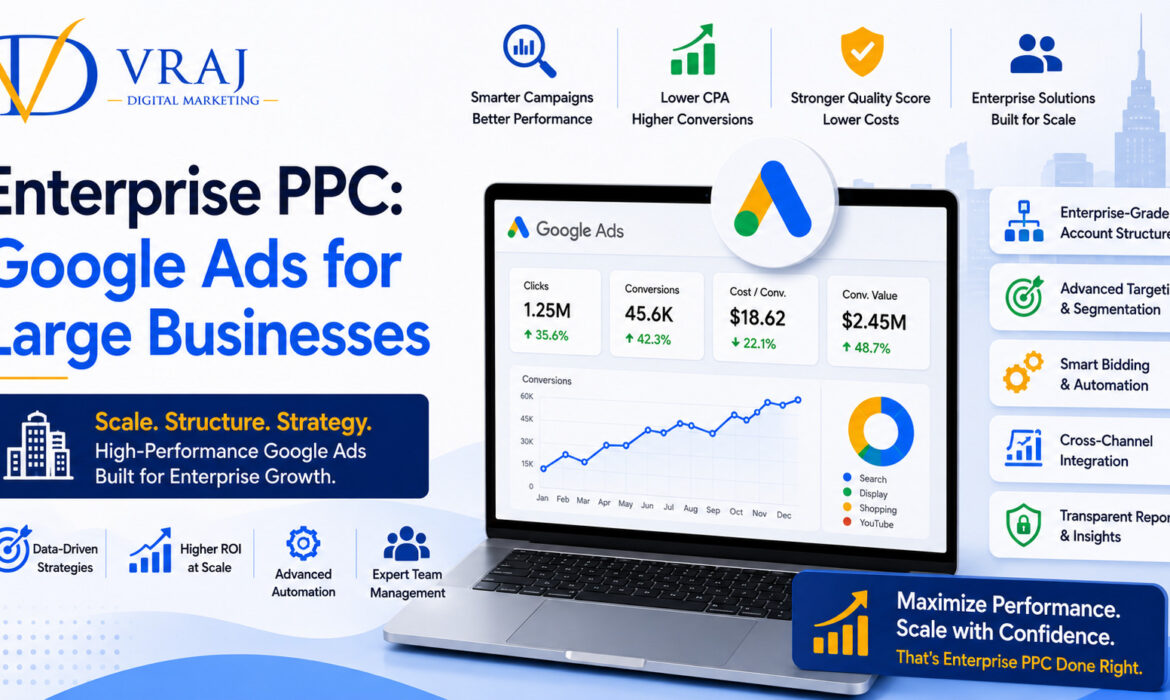
ToggleEnterprise PPC: Google Ads for Large Businesses
Key Takeaways
- Enterprise PPC requires a fundamentally different strategy than small-business Google Ads — scale, structure, and data infrastructure matter more than budget alone.
- Poor account architecture at enterprise scale doesn’t just waste money — it compounds across thousands of keywords and millions of impressions.
- According to WordStream’s 2024 PPC Benchmark Report, businesses that invest in structured campaign management see up to 3x better conversion rates than unmanaged accounts.
- Quality Score optimization at enterprise level can reduce cost-per-click by 20–30% — a difference worth hundreds of thousands of dollars annually at high spend levels.
- The right enterprise PPC agency pays for itself. The wrong one burns your budget quietly, month after month.
Enterprise PPC is paid advertising at scale — managing Google Ads campaigns that span thousands of keywords, multiple product lines, large geographic markets, and complex audience segments, all simultaneously. For entrepreneurs and founders running growth-stage or enterprise businesses in the USA, this isn’t optional anymore. It’s infrastructure.
I’m Dipesh, founder of Vraj Digital Marketing, with 4+ years managing Google Ads and over $100,000 in ad spend across competitive US markets. Here’s everything you need to know about enterprise PPC — and why getting it right is one of the highest-leverage decisions you’ll make.
What Is Enterprise PPC and Why Does It Differ From Standard Google Ads?
Enterprise PPC is paid search management at a scale where standard campaign structures, manual optimizations, and single-manager account oversight break down. It requires specialized architecture, automation frameworks, and cross-channel data integration that small-business Google Ads campaigns simply don’t need.
The difference isn’t just budget. A $500/month Google Ads account and a $50,000/month account don’t just differ in spend — they differ in complexity by an order of magnitude. Keyword volumes, audience layers, bidding logic, and creative testing all multiply. Without the right systems, that complexity becomes chaos, and chaos burns money.
Why Do Large Businesses Need a Dedicated Enterprise PPC Agency?
Large businesses need an enterprise PPC agency because the volume of decisions required to manage high-spend campaigns correctly exceeds what any single in-house manager — or generalist agency — can handle without specialized tools, processes, and cross-client pattern recognition.
Here’s the thing: at enterprise scale, even a 5% inefficiency in your Google Ads account isn’t a minor inconvenience. On a $100,000/month budget, that’s $5,000 wasted every single month — $60,000 per year. An enterprise PPC agency exists to eliminate those inefficiencies systematically, not reactively.
What enterprise agencies provide that standard agencies don't:
- Dedicated team per account (strategist, analyst, CRO specialist)
- Access to Google’s Premier Partner support and beta features
- Enterprise-grade platforms like Search Ads 360 (SA360) or Kenshoo (Skai)
- Cross-account performance benchmarking and industry data
- Integrated reporting across paid search, paid social, and programmatic
How Does Google Ads Account Structure Differ at Enterprise Scale?
At enterprise scale, Google Ads account structure becomes a system-design problem, not just a campaign-organization task. You’re managing hundreds of ad groups, thousands of keywords, multiple conversion goals, and audience segments that interact with each other in ways that require architectural thinking — not just common sense.
According to Google’s internal quality data, advertisers with tightly segmented, intent-matched ad groups consistently achieve Quality Scores of 7–9, compared to 3–5 for loosely structured accounts. That gap translates directly to lower CPCs and better ad placement across every keyword in your account — at scale, that’s a compounding advantage.
Enterprise account structure best practices:
- Segment campaigns by product line, geography, and funnel stage — separately
- Use tightly themed ad groups with 5–15 keywords maximum per group
- Build dedicated landing pages per campaign theme, not per ad group
- Implement shared negative keyword lists across all campaigns
- Separate branded and non-branded campaigns with distinct bidding strategies
What Role Does Quality Score Play in Enterprise PPC?
Quality Score is Google’s rating of your ad relevance, expected click-through rate, and landing page experience — scored 1–10 per keyword. At enterprise scale, Quality Score isn’t just a metric to monitor; it’s a cost multiplier that affects every dollar you spend.
A Quality Score of 10 gives you up to a 50% discount on your CPC versus a score of 5. A score of 3 means you’re paying up to 67% more than the advertiser with a 7 for the same position. Multiply those cost differences across thousands of keywords and millions of impressions, and Quality Score optimization becomes one of the highest-ROI activities in enterprise PPC marketing.
How to improve Quality Score at scale:
- Align ad copy precisely to keyword intent — not just keyword inclusion
- Build single-theme ad groups where every keyword matches every ad
- Test landing page load speed — Google measures it as part of page experience
- Use Responsive Search Ads (RSAs) with high ad strength ratings
- Monitor Search Term Reports weekly to cut irrelevant match traffic
How Does Smart Bidding Work in Enterprise Google Ads Campaigns?
Smart Bidding is Google’s machine learning-powered bid automation — strategies like Target CPA, Target ROAS, and Maximize Conversions that adjust bids in real time based on auction signals. At enterprise scale, Smart Bidding is essential, but it requires proper setup to work correctly.
The real issue is that Smart Bidding is only as smart as the data you feed it. If your conversion tracking fires on the wrong event, tracks duplicate conversions, or doesn’t capture offline sales data, the algorithm optimizes toward the wrong outcome — and does it confidently, at scale. That’s a dangerous combination.
Smart Bidding requirements for enterprise accounts:
- Minimum 30–50 conversions per month per campaign before switching to Target CPA
- Clean, deduped conversion tracking with verified value assignments
- Offline conversion imports for businesses with sales cycles longer than 30 days
- Separate bidding strategies for branded vs. non-branded traffic
- Regular performance target reviews — don’t set targets and walk away
What Is Search Ads 360 and Do Enterprise Businesses Need It?
Search Ads 360 (SA360) is Google’s enterprise campaign management platform — built for advertisers managing large-scale paid search across multiple accounts, engines, and markets simultaneously. It offers cross-engine bidding, advanced reporting, and Floodlight conversion tracking that the standard Google Ads interface doesn’t support at scale.
Most businesses spending under $30,000/month don’t need SA360. But above that threshold — especially if you’re running campaigns across Google, Microsoft Ads, and other search engines simultaneously — SA360 provides centralized control and data visibility that pays for itself in optimization efficiency.
How Should Entrepreneurs Evaluate an Enterprise PPC Agency?
Entrepreneurs evaluating an enterprise PPC agency should look beyond case studies and ask direct questions about account structure philosophy, testing cadence, reporting transparency, and how they handle Smart Bidding data integrity — because those are the areas where most agencies cut corners.
The questions that reveal the most:
Ask these 5 questions before signing any agency contract:
- “Can I see an example account structure you’ve built at our budget level?” — Vague answers mean generic setups.
- “How do you handle conversion tracking audits before launching campaigns?” — If they skip this step, your data will be wrong from day one.
- “What’s your testing cadence — how many A/B tests do you run per month, per campaign?” — Agencies that don’t test systematically don’t improve systematically.
- “How do you measure success beyond ROAS?” — Look for answers that include CAC, LTV, and revenue attribution.
- “What reporting do we get, and how often?” — Weekly performance updates are the standard for any serious enterprise engagement.
What PPC Marketing Metrics Actually Matter for Enterprise Businesses?
ROAS is the metric everyone watches. It’s not the metric that tells you whether your PPC marketing strategy is actually working for long-term business growth.
For entrepreneurs and founders, these are the metrics that connect paid search performance to business outcomes:
- Cost Per Acquisition (CPA): What you pay to acquire one customer — not one lead, one customer.
- Customer Lifetime Value (LTV) to CAC Ratio: If LTV:CAC is below 3:1, your paid acquisition model needs restructuring.
- Impression Share: The percentage of eligible auctions you appear in. Low impression share means competitors own your market visibility.
- Search Lost IS (Budget) vs. (Rank): These tell you whether you’re losing auctions to budget constraints or to poor Quality Score — two very different problems with very different solutions.
- Assisted Conversions: Enterprise buyers rarely convert on the first click. Assisted conversion data shows you the full path.
According to HubSpot’s 2024 State of Marketing Report, 61% of marketers cite improving lead quality as their top priority — not volume. Enterprise PPC done right solves both.
Is Your Google Ads Account Built to Scale?
Most enterprise-level Google Ads accounts have at least three structural problems silently draining budget right now. The businesses that scale fastest are the ones that find and fix those problems before competitors do.
We’ll audit your account structure, conversion tracking integrity, Quality Score distribution, and bidding strategy alignment — and deliver a prioritized action plan within 5 business days. No retainer required to start.
How Does a USA-Based Enterprise Business Choose Between In-House and Agency Management?
The in-house vs. agency decision for enterprise PPC comes down to one question: can you hire, retain, and develop a full paid search team — strategist, analyst, CRO specialist, and tracking engineer — for less than the cost of an agency retainer plus the revenue you’d generate from that agency’s performance uplift?
For most USA-based businesses spending $30,000–$200,000/month on Google Ads, the answer is no. A specialized enterprise PPC agency brings cross-client benchmarking data, platform relationships, and optimization depth that a single in-house hire — or even a small team — can’t replicate in year one or two.
That said, the right hybrid model often wins: an agency handling strategy and execution, with an in-house marketing lead managing brand alignment and creative direction.
Frequently Asked Questions
What is an enterprise PPC agency?
An enterprise ppc agency manages large scale paid search campaigns. Enterprise ppc agency handles more than $30,000 or more than per month on Google Ads. We handle use platform like search ads 360, run dedicated teams and integrate paid search data.
How much does enterprise PPC management cost?
Enterprise ppc agency charges $3,000 to $15,000+ per month. Still it depends on ads spends, campaign complexity, scope, etc.
What is a good ROAS for enterprise Google Ads campaigns?
ROAs depend on various businesses, if it is an eCommerce business 2% is the conversion rate and if it is a service based business 5% is minimum.
How long does it take to see results from enterprise PPC?
Initial data and early optimizations are visible within the first 30 days. Smart Bidding strategies typically require 60–90 days to exit the learning phase and stabilize performance. Full account optimization — including landing page testing, audience refinement, and negative keyword development — compounds over 6–12 months. Businesses that commit to a 6-month horizon consistently outperform those chasing 30-day results.
What is Quality Score and why does it matter for enterprise PPC?
Quality Score is Google's 1–10 rating of each keyword's ad relevance, expected CTR, and landing page experience. Higher Quality Scores mean lower CPCs and better ad positions. At enterprise scale — with thousands of keywords — even a one-point average Quality Score improvement can save tens of thousands of dollars in annual ad spend while simultaneously improving placement. It's the single most leveraged optimization lever in Google Ads.
Can a small agency manage enterprise PPC effectively?
It depends on the agency's systems, tooling, and team depth — not just their size. A boutique agency with deep Google Ads specialization, proper automation frameworks, and transparent reporting can absolutely manage $50,000–$100,000/month accounts effectively. The red flags to watch for are single-manager account ownership, no documented testing cadence, and reporting that only covers surface metrics like impressions and clicks without revenue attribution.
Our Blogs
Maximizing Your ROI with Google Ads in 2026
Table of Contents
Toggle
Maximizing Your ROI with Google Ads in 2026Why Google Ads ROI Matters More Than Ever in 2026Start...
How Much Do Google Ads Cost? A Complete Guide for Entrepreneurs
Table of Contents
Toggle
How Much Do Google Ads Cost? A Complete Guide for EntrepreneursIs Google Ads Free?What Is the...
Website Navigation Strategies for Optimal Website Performance
Table of Contents
Toggle
Website Navigation Strategies for Optimal Website PerformanceWhat is Website...

parmardipesh0007
Hey, I am Dipesh, I am a Digital Marketer. I like to make 2x of your business ROI using Google Ads, SEO, Facebook Ads.