Table of Contents
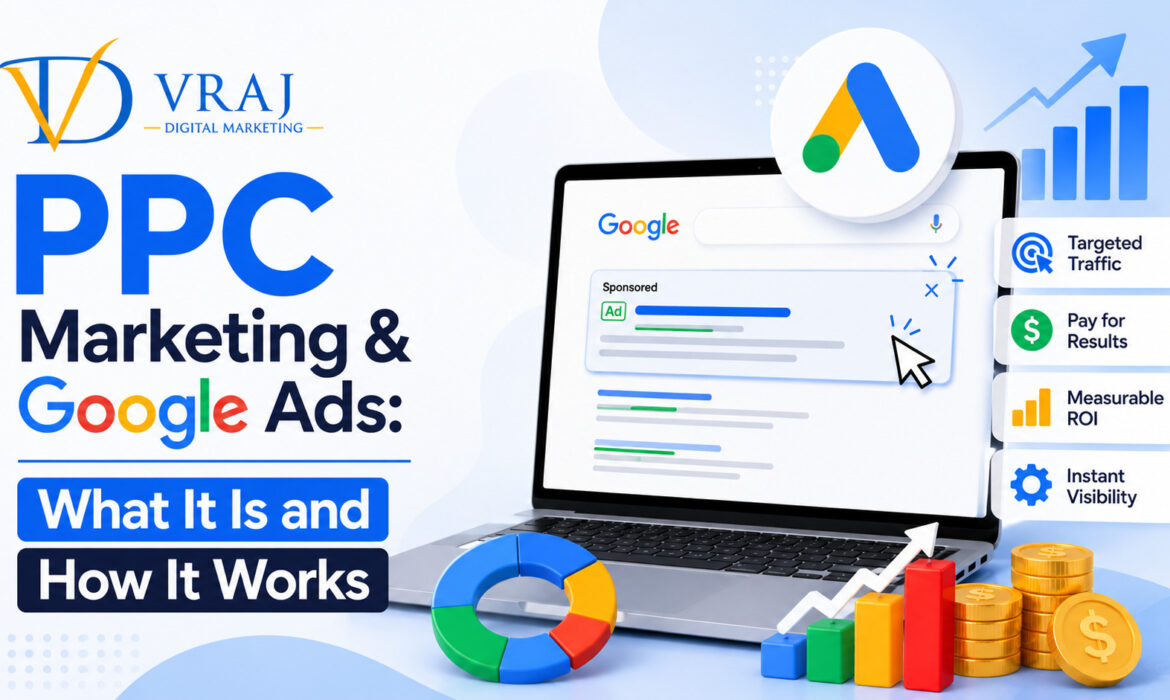
TogglePPC Marketing & Google Ads: What It Is and How It Works
What Is PPC Marketing?
PPC marketing or Pay per click marketing is a digital marketing advertising model where founders or businesses pay money for clicks or views. Organic ways take some time to get returned back. By using PPC marketing, founders can generate sales or leads within seven days. It works on several platforms such as Google, Bing, or social media. You can start PPC for small businesses to large businesses, PPC marketing delivers measurable, scalable results that directly support your revenue goals.
How Does PPC Marketing Work?
PPC marketing operates on a bidding system. Advertisers compete for ad placements by bidding on specific keywords. When a user searches for a term that matches your keyword, the platform runs an instant auction. The winner earns the top ad spot. You only pay when someone clicks your ad — not when they simply see it. This makes PPC one of the most cost-efficient advertising strategies available today, giving you full control over your budget and audience targeting.
Understanding Google Ads: The #1 PPC Platform
Google Ads is one of the largest PPC platforms. It allows businesses to display ads across Google search, YouTube, Gmail and Millions of partners website through Google Display Network. Over 8.5 billion searches happen on Google every day.
Types of Google Ads Campaigns
- Search Ads – Text-based ads that appear at the top of Google search results
- Display Ads – Visual banner ads shown across Google’s partner websites
- Shopping Ads – Product listings with images and prices for eCommerce stores
- Video Ads – Ads shown before or during YouTube videos
- App Campaigns – Ads promoting mobile app downloads across Google’s network
- Local Ads – Ads targeting nearby customers for physical store visits
- Performance Max – AI-powered campaigns that run across all Google channels
Key Components of a Successful PPC Campaign
Running a profitable PPC campaign requires more than just setting a budget. Every element must work together strategically. Here are the core components you need to master:
1. Keyword Research
Keyword research is one of the important parts in PPC marketing. You need to select proper keywords and then make ad group accordingly, It helps in quality score and sales or leads generation.
2. Ad Copywriting
Great ad copy drives clicks and conversions. Follow these key points to write high-performing Google Ads:
- Write a powerful headline — Include your primary keyword and lead with a clear benefit
- Craft a compelling description — Highlight your USP and address the user’s pain point directly
- Use a strong CTA — Be specific: “Get a Free Quote” beats “Click Here” every time
- Add ad extensions — Use sitelinks, callouts, and call extensions to boost visibility at no extra cost
- Match copy to search intent — Align your message with what the user actually wants
- A/B test regularly — Run 2–3 ad variations and keep the best performer
- Follow Google’s ad policies — Avoid misleading claims and ensure your landing page matches the ad
3. Quality Score
Google Ads assigns a quality score from 1 to 10 to each keyword. It depends on Landing Page, Ad relevance and Expected CTR. The more quality score you have the less CPC will require.
4. Landing Page Optimization
Send users to a dedicated landing page that matches the ad’s message. A fast, mobile-friendly page with a clear CTA converts visitors into leads and customers efficiently.
5. Bid Strategy
Choose the right bidding strategy for your goal — whether that’s maximizing clicks, targeting a specific CPA (Cost Per Acquisition), or improving return on ad spend (ROAS).
Bid strategy defines how you campaign will work. Following are bid strategies
Automated Bid Strategies:
- Target CPA (Cost Per Acquisition)
- Target ROAS (Return on Ad Spend)
- Maximize Conversions
- Maximize Conversion Value
- Enhanced CPC (ECPC)
Manual Bid Strategies:
- Manual CPC (Cost Per Click)
Awareness-Based Bid Strategies:
- Target Impression Share
CPM (Cost Per Thousand Impressions) - tCPM (Target CPM)
Video Bid Strategies:
- CPV (Cost Per View)
- Target CPV
6. Conversion Tracking
Conversion is one of the most important parts in Google Ads. Before starting any ads You should make proper conversion actions
Conversion actions are
- Form submibssion
- Call
- Add to cart
- Checkout
How Google Ads Auction Works
Every time someone performs a Google search, an automated auction takes place in milliseconds. Google determines which ads appear and in what order using a formula called Ad Rank. Here’s how it breaks down:
Ad Rank = Bid Amount × Quality Score × Expected Impact of Ad Extensions
A higher Ad Rank means better placement. This means you don’t always need the highest bid to win. A well-optimized ad with a high Quality Score can outrank competitors who spend more. This levels the playing field for businesses of every size, making Google Ads both fair and performance-driven.
Benefits of PPC Marketing for Your Business
PPC marketing delivers distinct advantages that organic SEO alone cannot always provide. Here’s why thousands of businesses invest in it daily:
- Immediate Results – Your ads go live within hours of campaign launch, unlike SEO which takes months
- Precise Targeting – Reach users by location, device, language, age, interests, and search intent
- Full Budget Control – Set daily and monthly limits; never overspend your advertising budget
- Measurable ROI – Track every click, conversion, and rupee spent with real-time data
- Brand Visibility – Even if users don’t click, your brand appears at the top of search results
- Competitive Edge – Appear above organic results and outrank competitors instantly
- Scalability – Scale successful campaigns up or down based on performance and business needs
PPC Marketing vs. SEO: What's the Difference?
Many business owners wonder whether they should invest in PPC marketing or SEO. The truth is — both work best together. Here’s a clear comparison:
| Feature | PPC Marketing | SEO |
|---|---|---|
| Speed | Instant results | Takes 3–6 months |
| Cost | Pay per click | Free (time investment) |
| Visibility | Top of search page | Below paid ads |
| Targeting | Highly precise | Broader audience |
| Long-term Value | Stops when budget ends | Compounds over time |
For businesses that need leads now, PPC delivers. For sustainable long-term growth, SEO builds authority. Together, they form a complete digital marketing strategy.
How to Set Up Your First Google Ads Campaign
Follow these steps to launch your first PPC campaign on Google Ads:
- Create a Google Ads account at ads.google.com
- Set your campaign goal (Sales, Leads, Website Traffic, etc.)
- Choose your campaign type (Search, Display, Shopping, etc.)
- Define your target audience — location, language, device
- Research and add keywords relevant to your business
- Write your ad copy — headline, description, and display URL
- Set your daily budget and bidding strategy
- Create or optimize your landing page
- Enable conversion tracking via Google Tag or Google Analytics
- Launch the campaign and monitor performance daily
Common PPC Mistakes to Avoid
Even experienced marketers make costly errors. Avoid these common PPC pitfalls:
- Ignoring negative keywords — Block irrelevant searches to save budget
- Sending traffic to the homepage — Always use a specific, relevant landing page
- Not testing ad variations — Run A/B tests to find the best-performing copy
- Skipping conversion tracking — You can’t optimize what you don’t measure
- Setting and forgetting — PPC campaigns require regular monitoring and adjustments
Frequently Asked Questions
What does PPC stand for in marketing?
PPC stands for Pay-Per-Click. It is a digital advertising model where advertisers pay a fee each time a user clicks on their ad. It allows businesses to buy targeted website traffic instantly rather than earning it organically through SEO.
How much does PPC marketing cost in India?
PPC costs vary widely based on your industry, competition, and keywords. In India, the average cost-per-click (CPC) ranges from ₹5 to ₹200 or more. You set your own daily budget, so you have complete control over spending. Even a modest daily budget of ₹500–₹1,000 can generate measurable results for local businesses.
Is Google Ads the same as PPC?
Google Ads is the most popular PPC platform, but they are not exactly the same thing. PPC is the broader advertising model, while Google Ads is one specific platform that uses the PPC model. Other PPC platforms include Meta Ads, Microsoft Ads, LinkedIn Ads, and Amazon Ads.
How long does it take to see results from PPC?
Unlike SEO, PPC delivers results almost immediately. Once your campaign goes live and Google approves your ads (usually within a few hours), you can start receiving clicks and leads the same day. However, optimal performance typically takes 2–4 weeks of data collection and campaign refinement.
Can small businesses benefit from PPC marketing?
Absolutely. PPC marketing is highly scalable, making it ideal for businesses of any size. Small businesses can start with a limited daily budget, target a specific local area, and compete with larger brands by focusing on niche, high-intent keywords. The key is smart campaign setup and continuous optimization.
What is a good click-through rate (CTR) for Google Ads?
The average CTR for Google Search Ads across all industries is around 3–5%. A CTR above 5% is considered strong. A low CTR often signals that your ad copy needs improvement or that your keywords don't match your audience's intent closely enough.
Do I need a PPC agency or can I manage it myself?
You can manage Google Ads yourself, especially for simple campaigns. However, working with a certified PPC agency like Vraj Digital Marketing ensures your budget is spent efficiently, campaigns are continuously optimized, and you achieve the best possible return on investment — saving you both time and money.
Our Blogs
Maximizing Your ROI with Google Ads in 2026
Table of Contents
Toggle
Maximizing Your ROI with Google Ads in 2026Why Google Ads ROI Matters More Than Ever in 2026Start...
How Much Do Google Ads Cost? A Complete Guide for Entrepreneurs
Table of Contents
Toggle
How Much Do Google Ads Cost? A Complete Guide for EntrepreneursIs Google Ads Free?What Is the...
Website Navigation Strategies for Optimal Website Performance
Table of Contents
Toggle
Website Navigation Strategies for Optimal Website PerformanceWhat is Website...

parmardipesh0007
Hey, I am Dipesh, I am a Digital Marketer. I like to make 2x of your business ROI using Google Ads, SEO, Facebook Ads.